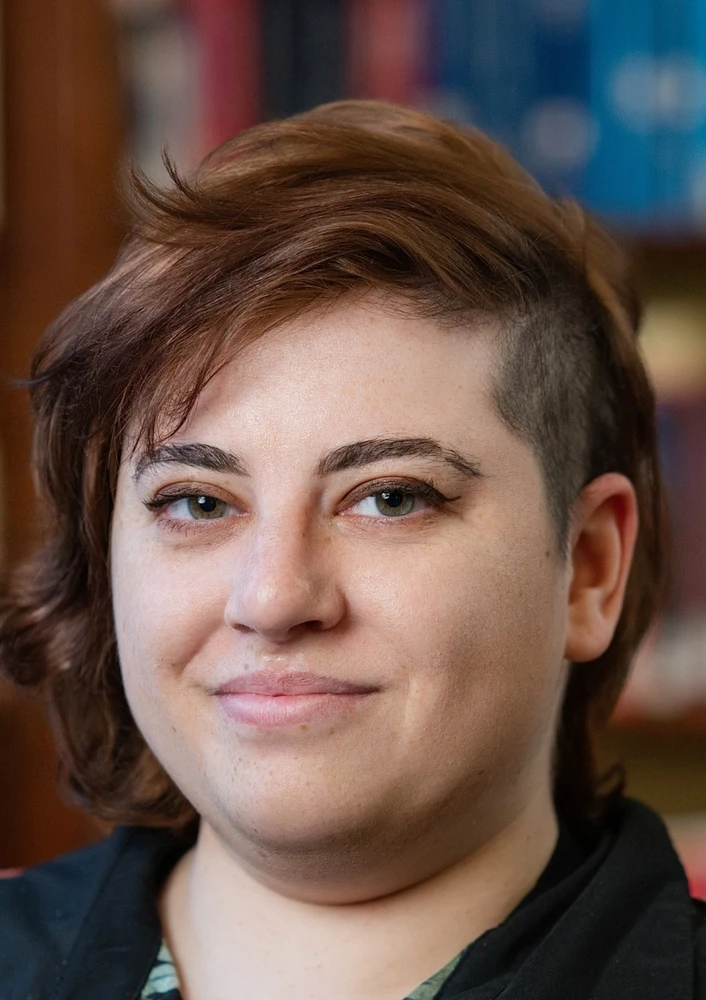
After taking her first fencing lesson at age 15, graduate student Alyssa Hirsch not only fell in love with the sport, but also developed a new interest in history.
Her coach, Anatolie Senic, immigrated to the United States from the Soviet Union. Hirsch knew she wanted to learn more from the stories of Soviet fencing coaches who came to America, the topic that guides her dissertation research at the University of Illinois.
“The more I got to know him, I was like, ‘What are you doing in Troy, Michigan?’ … ‘What brought you here?’” Hirsch said. “[That] fueled me to pursue history.”
Growing up in Huntington Woods, Michigan, a Detroit suburb, Hirsch remained involved in the world of fencing throughout college. She fenced varsity at Wayne State University, where she earned her bachelor’s degree in 2021, and coached at Purdue University, where she graduated with her master’s in 2023.
For Hirsch, coming to Illinois to further her academic career was a decision she said she would have been “stupid not to take.” She credits the diversity of the history department faculty and opportunities for Russian language development for drawing her to the program.
Hirsch’s research investigates specifically how and why fencing coaches came to the United States after the collapse of the Soviet Union.
“They were a part of this big Soviet sports system for so long, and then when your entire world just collapses, what do you do?” Hirsch said.
Hirsch is interested in how the United States has become a “place for them to express aspects of their Soviet identity,” along with “parts of their ethnic identity that might have been suppressed while in the Soviet Union.”
This expression is reflected through the continuation of their involvement in the sport, such as starting their own businesses and coaching.
“That’s also really interesting to see how they kind of have created … a new image of themselves through immigration and placemaking,” Hirsch said.
She has contacted over 30 coaches thus far, and describes her mindset as being “here to learn” as she works on a project largely comprised of these oral histories. Not only is she learning from the interviews, but her meetings with the coaches also consist of her taking a fencing lesson, deepening her understanding of their knowledge.
Hirsch is planning on traveling across the country to conduct more interviews, including stops in Ohio, California, and New York. She is also planning a trip to Washington, D.C., in August to review immigration records and archives.
As she continues through this process, Hirsch is working alongside professor Adrian Burgos Jr., her advisor, and also receives support from professor Marc Hertzman.
Hirsch said that Hertzman has been “emotional support through tough times” and has pushed her to “be better at understanding race and ethnicity as [an] analytical framework.”
Along with her research, Hirsch has also found a passion for teaching at Illinois, describing it as her “favorite part of grad school by far.” She was a teaching assistant for HIST 281: Constructing Race in America in Fall 2025 and HIST 209: World War II: A Global History in Spring 2026.
“Whenever I would step in a classroom, and I would teach, it feels like literally everything else just melts away,” Hirsch said. “I really enjoy getting to know students, and seeing that realization when they learn something new … that’s the most rewarding thing.”
For her work as a TA in HIST 281, Hirsch was given the Facilitating Learning Excellence Award, which is based on a ranking system of course evaluations from students.
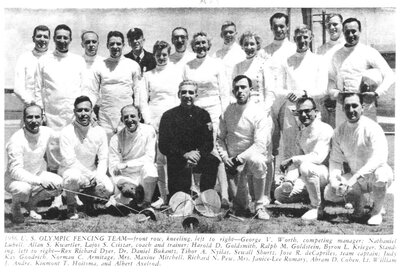
Next year, she will devote more time to research and won’t be able to teach, but hopes to teach a standalone course in the future.
“I’ve made a couple syllabuses already,” Hirsch said. “One of them would be history of the Olympics – each week is focusing on one or two different Olympic cycles and also the political stakes of each one.”
At Illinois, Hirsch has also been a part of the History Graduate Student Association and a member of the department’s Undergraduate Studies Committee. She is also part of the University’s Graduate Employees’ Organization, where she met some of her best friends.
Hirsch hopes to graduate in May 2028. Looking toward her future, she sees herself as a lecturer or professor at an R1 research university. Ideally, this will take her closer to home in Michigan, or even to her alma mater at Wayne State.
“I love it here, it’s great,” Hirsch said. “But there’s something about just being able to go home … there’s a hole in your heart that gets filled.”