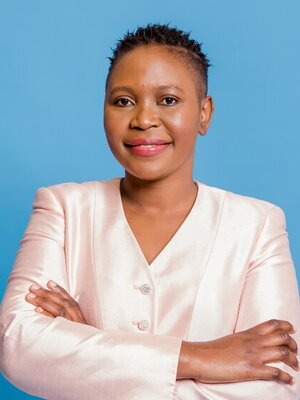
When graduate student Ruth Veida Mandala was growing up in Malawi, she always knew she wanted to study history but thought her path would lead to law school. When she was selected for the education program at the University of Malawi she initially hated the idea of becoming a teacher. However, she soon discovered that she belonged in the classroom.
“People say, is a teacher born or made? I would say that teaching comes naturally in a way for me. It’s not something I had to settle into,” she said.
After graduating with a bachelor's degree in history and education, she taught secondary school for three years before earning her master’s in African social history from the University of Malawi. She taught as a teaching assistant while completing her MA and was a history lecturer at the university after graduating. By the time she began her PhD program at the University of Illinois Urbana-Champaign in 2020, she had many years of teaching experience under her belt.
“I love teaching because I love that you get to learn continuously and even when you're teaching some subject for the second, third, fourth time, I find that the experience is new every time because you have to keep up. You have to update yourself. You have to continuously ask questions and be curious,” she said.
Her approach to teaching is collaborative and encourages active participation and discussion from students.
“I tell them, section is not about me. Section is about you. So then when you come to section, I expect that you are ready to discuss, share your ideas,” she said. “The sections are not about me being an expert. You're going to learn from me and I will learn from you.”
Her natural talent was recognized by the Department of History, which awarded her the 2025 Dr. Charles DeBenedetti Award for Teaching Excellence by a Teaching Assistant. She said she’s loved being a teaching assistant for a variety of courses in the department and teaching students from other majors.
“In Malawi, when you are teaching history, you likely teach people who will become history teachers. You don't get to teach somebody studying business administration or biology, but here I love that you get to interact with students from different fields,” she said.
Studying Africans in urban colonial Malawi
In addition to teaching, she’s also enjoyed working with professor James Brennan, a historian of urban Tanzania, who was the reason she decided to apply to Illinois. Her master’s thesis focused on urban youth culture in Malawi, particularly music and dance, and she knew wanted to dive deeper into urban history for her PhD.
Mandala’s research studies educated Africans in urban colonial Malawi, analyzing how they built community, identity, and navigated class structures under racial segregation. Current scholarship on Malawi tends to focus on European influence and rural areas. She was curious about what it was like for educated Africans to navigate systems where they were continuously reminded that they are not equal.
“When looking at colonial history, it's often the colonizer versus the colonized, right? And in this context, it would be Europeans versus Africans. But in my work, I ask how class shaped African experiences within urban spaces. I am particularly interested in how spaces such as community centers, cinemas and social clubs became sites where Africans negotiated belonging and identity,” she said.
By centering class, she’s able to provide a fuller picture of what life was like for Africans in urban Malawi and understand how they shaped what the country’s cities look like today.
Another faculty member who’s influenced her work is professor Antoinette Burton, who taught one of her first-year seminars. Part of the course focused on history outside of academia, which inspired Mandala to think about how she can share Malawian history with the public.
Sharing Malawi history with the public
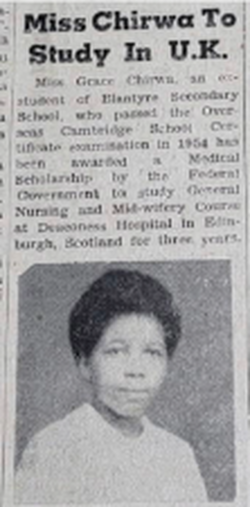
Through her Facebook page, Tales & Tunes, she uses music, photographs and storytelling as historical sources while inviting the public to actively contribute to a collaborative digital archive. She said she wants to make history relatable and accessible to audiences outside of academia.
“People get very excited when they learn stories about their own pasts, but also stuff that they did not learn in school,” she said.
She focuses on telling stories about ordinary people and invites the community to fill in the gaps if they have information she couldn’t access.
“Malawi is not a huge country. It's quite small. So there's always a chance that when I post something there will be somebody who knows a family member, a granddaughter, somebody, and then they'll share more on this person,” she said.
Recently, she shared a story she found about a woman who left rural Malawi in 1955 to attend university in the United Kingdom. Mandala was curious to know what happened to the woman, so she shared the story on her Facebook page.
“I can tell you in an hour that person was found. They’re like, oh, she lives in Tanzania. She’s just celebrated her 90th birthday,” she said.
The collaborative spirit of the page is what makes the project so special to Mandala.
“I look at the Facebook page as a digital archive that, years from now, people should be able to come to it and see these different stories on Malawi and get different viewpoints from different people who I may not have access to, if not for that page,” she said. “We are building the archive together. We are writing the history together, and I get to learn from them as much as they also learn from me, which is very exciting.”
Mandala plans to defend her dissertation this summer. While she continues to explore future paths, she is certain that teaching and public engagement will remain central to her work.