Image
Using public and digital history methods, our faculty connect their work with communities outside the walls of the university to create new meanings and foster better understandings of why history matters. Browse the inventive, community-centered work our faculty are doing to connect their research with the wider public below.
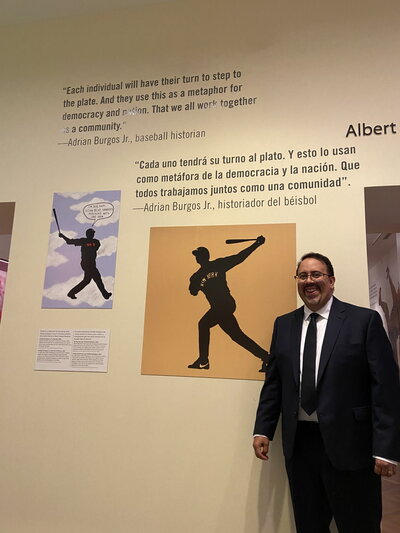
¡Pleibol!, an exhibit at the National Musuem of American History that professor Adrian Burgos, Jr. co -created, examined how generations of Latina/os have helped make baseball what it is today. From youth and community teams to the Major League, the exhibition revealed how baseball brings people together regardless of race, class, or gender. A website companion website gives visitors the opportunity to experience many of the objects and stories featured in ¡Pleibol!, and offers a selection of historical artifacts as high-resolution, narrated 3D scans. A touring version of the exhibit is on display around the country through 2027.
Net.Create is an open-source analysis tool that offers simultaneous multi-user network-data entry that accommodates duplicate and ambiguous network data, provides live visualizations of up-to-the-minute entries from other team members, and is structured around clear citational and interpretive practices.
DigitalArc is designed to require minimal technical skills and allows users to create a digital archive website for community, personal, or familial history projects.
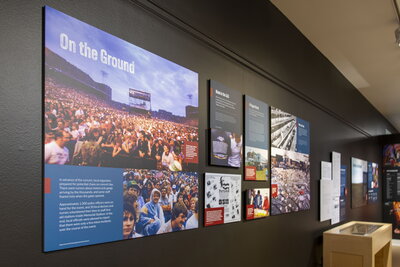
In September 1985, Memorial Stadium at the University of Illinois was the site of the first Farm Aid relief concert for American farm families, featuring a lineup of legends like Willie Nelson, Neil Young, B. B. King, Loretta Lynn, and Bob Dylan. Inspired by this local event, professor Daniel Gilbert made Farm Aid the focus of study for the spring 2023 History Harvest class. History Harvest is a collaborative public history project in which students engage with members of the public to collect and digitize documents and artifacts of historical interest for scholarly and community research. Together with Spurlock Museum and the Champaign County History Museum they organized an exhibit at Spurlock in 2025 commemorating the 1985 Farm Aid concert.
Professor Rosalyn LaPier served as an advisor for "Bison Standing Strong," an exhibit exploring the enduring cultural and ecological legacy of American bison at the National Museum of Natural History. The exhibit is part of the 250th anniversary of the United States celebrations.
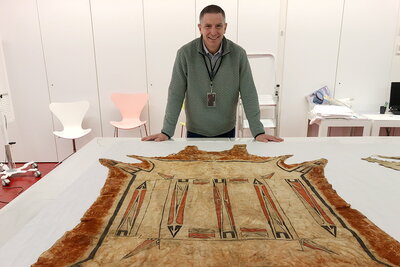
Digital humanities project on hide painting and tattooing in Indigenous Illinois culture. Project developed in partnership with Peoria and Miami Tribes to document cultural revitalization efforts.
Learn more about the Reclaiming Stories project
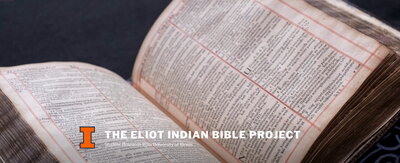
Student research on the John Eliot Bible owned by University of Illinois Rare Book and Manuscript Library in a class taught by professor Robert Morrissey. The project culminated in a digital exhibit covering provenance and book history, along with historical interpretation of the first Bible ever published in North America.
Learn more about the Eliot Indian Bible Project
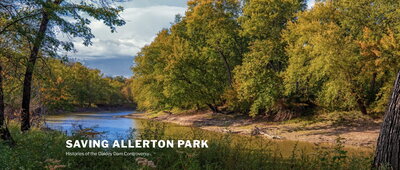
Student research in a class taught by professor Robert Morrissey about a campaign to prevent a dam on the Sangamon River near Decatur which would have affected regional environment, particularly the nature preserve at Allerton Park. The project was undertaken as a “Humanities Research Lab” in partnership with the Allerton Park Visitors Center, 2024 and culminated in a digital exhibit.
Learn more about the Oakley Dam Project
A group research project that grew out of a Mellon-Funded Environmental Humanities Initiative. The project includes work by students, postdocs, and professor Robert Morrissey.
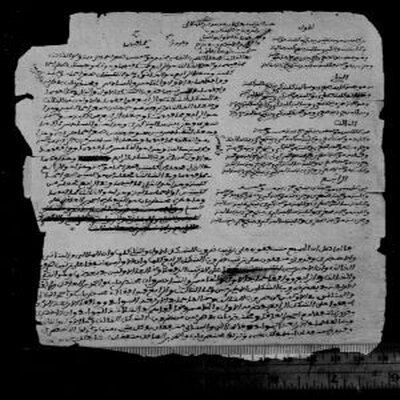
An open-access digital collection of translated and contextualized Arabic manuscripts from Muslim West Africa. A collaborative effort between Northwestern University and the University of Illinois at Urbana-Champaign, Maktaba is dedicated to making portions of the African manuscript collections from these universities’ libraries accessible to a wide variety of users for learning, teaching, and research. Professor Mauro Nobili is one of the directors of the project that is co-sponsored by the National Endowment for the Humanities, the Center for African Studies at the University of Illinois Urbana-Champaign, and the Institute for the Study of Islamic Thought in Africa at Northwestern University.
A digital humanities collective where students can learn how to publish digital documentary editions of historical sources and explore the opportunities and challenges of being a historian in a digital age. Created by professor John Randolph.
309 Gregory Hall, MC-466
810 S Wright St
Urbana, IL 61801
Email: history@illinois.edu