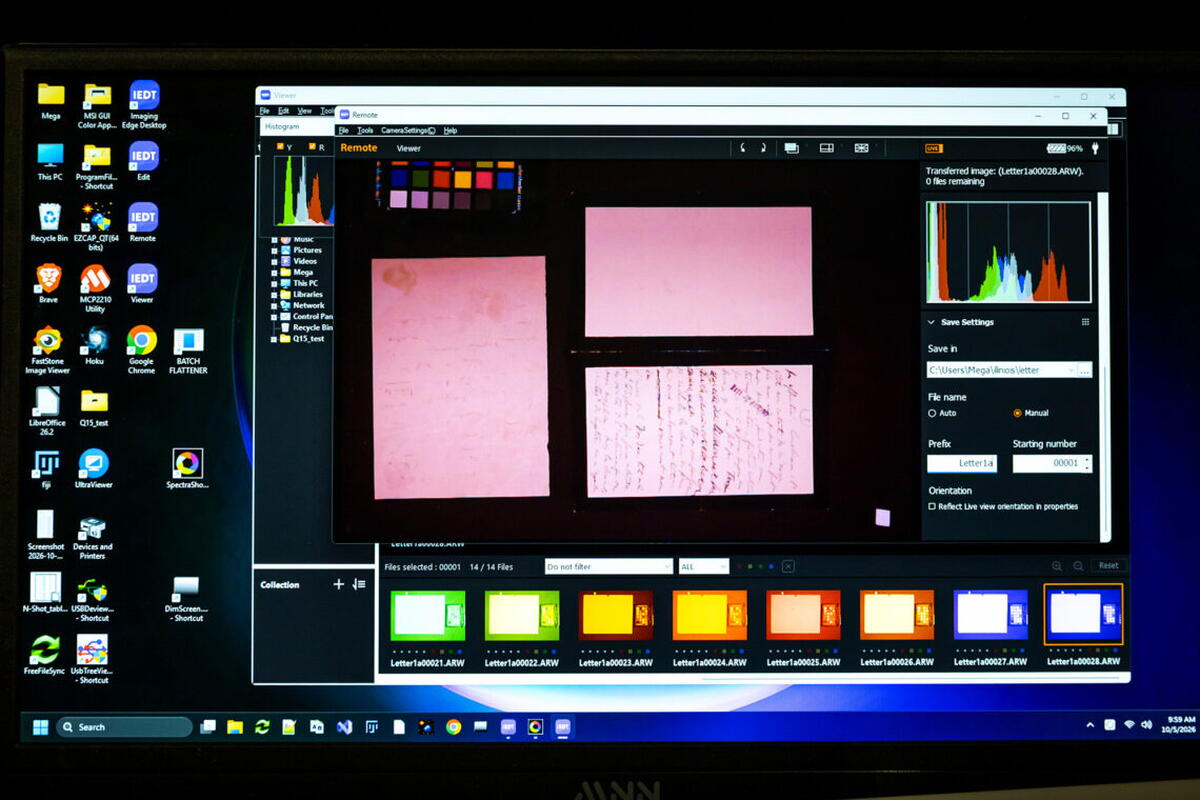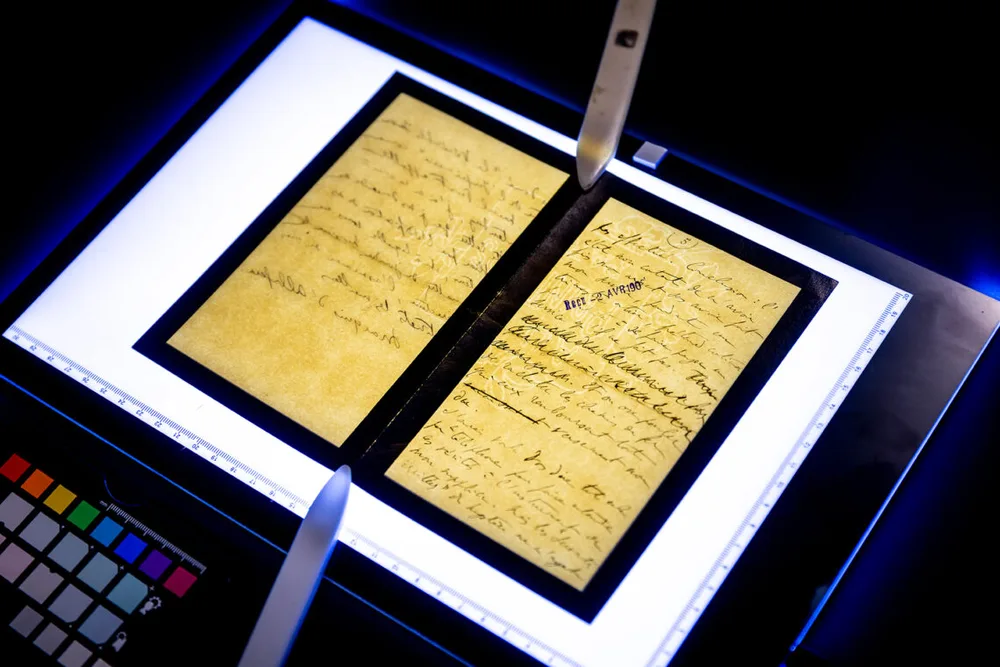
Researchers recently used multispectral imaging technology to try to uncover hidden information from medieval manuscripts at the Rare Book and Manuscript Library at the University of Illinois Urbana-Champaign. The library hosted a digital imaging workshop in early October that served as a pilot study for how the technology can help analyze fragile, centuries-old documents.
Illinois history professor Kalani Craig, who organized the workshop, is a digital historian who designs tools and platforms for new historical methods. Multispectral imaging technology uses multiple wavelengths of light pointed at a document for ink recovery of faint images not otherwise legible. Craig worked with RBML curator Cait Coker to identify manuscripts that would lend themselves to digital imaging analysis.
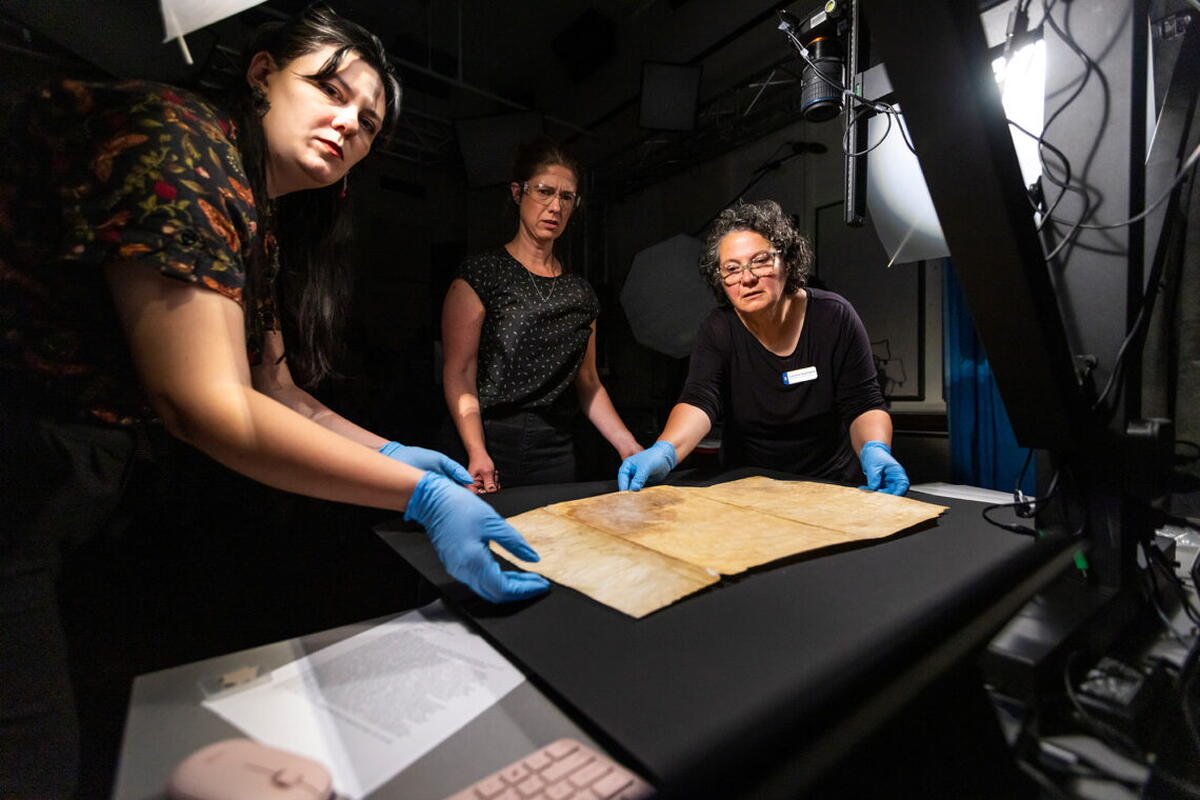
One such manuscript is a parchment, the “Leaf from the Rental of the Abbey of St. Martin de Tours,” from an 8th century records book detailing the taxes paid to one of the oldest abbeys in France. The pages of the record book were separated by scholars in the 17th and 18th centuries. This leaf was held by a private collector before being acquired by RBML through a gift by James and Lionelle Elsesser of St. Louis, who are Illinois alumni and supporters of the University Library, Coker said.
The parchment has a Greek papyrus glued to its back. The papyrus dates from the 6th or 7th century and is the oldest surviving papyrus document from north of the Alps, Coker said. The badly deteriorated papyrus has a poem written on it, and Coker hoped the imaging might help identify a few more lines.
“There has been so much deterioration over the past 12 centuries, the papyrus is basically in threads, but there are spots where the ink from the papyrus sticks to the parchment itself,” Coker said. “It’s a unique opportunity to look at this object.”
Craig is part of a team of scholars known as Videntes: A Multispectral Imaging Collective that brought its digital imaging system, used for preservation and study of cultural objects, which provides high-resolution photography and multispectral imaging. Two members of the Videntes collective, Helen Davies, an English professor at the University of North Carolina at Charlotte, and Katie Albers-Morris, an English professor at the Rochester Institute of Technology, led the imaging workshop. Other members of the Videntes group and of the Peripheral Manuscripts Project team, based at Indiana University, participated in the workshop, along with University Library professors and staff members.
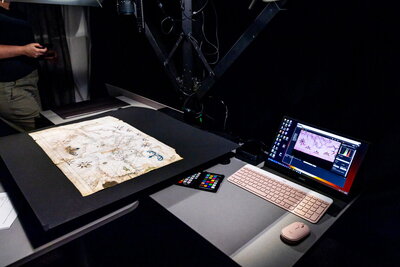
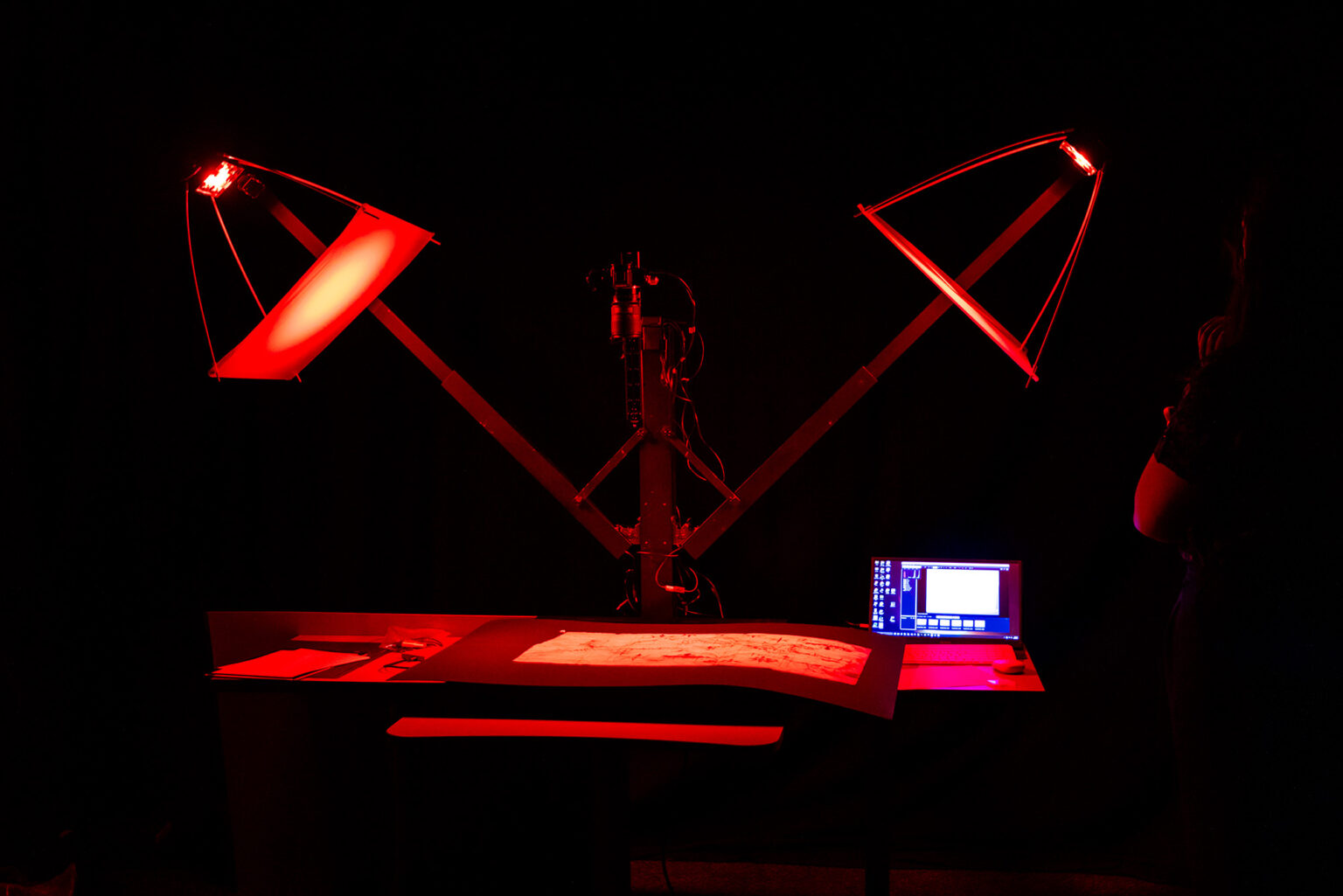
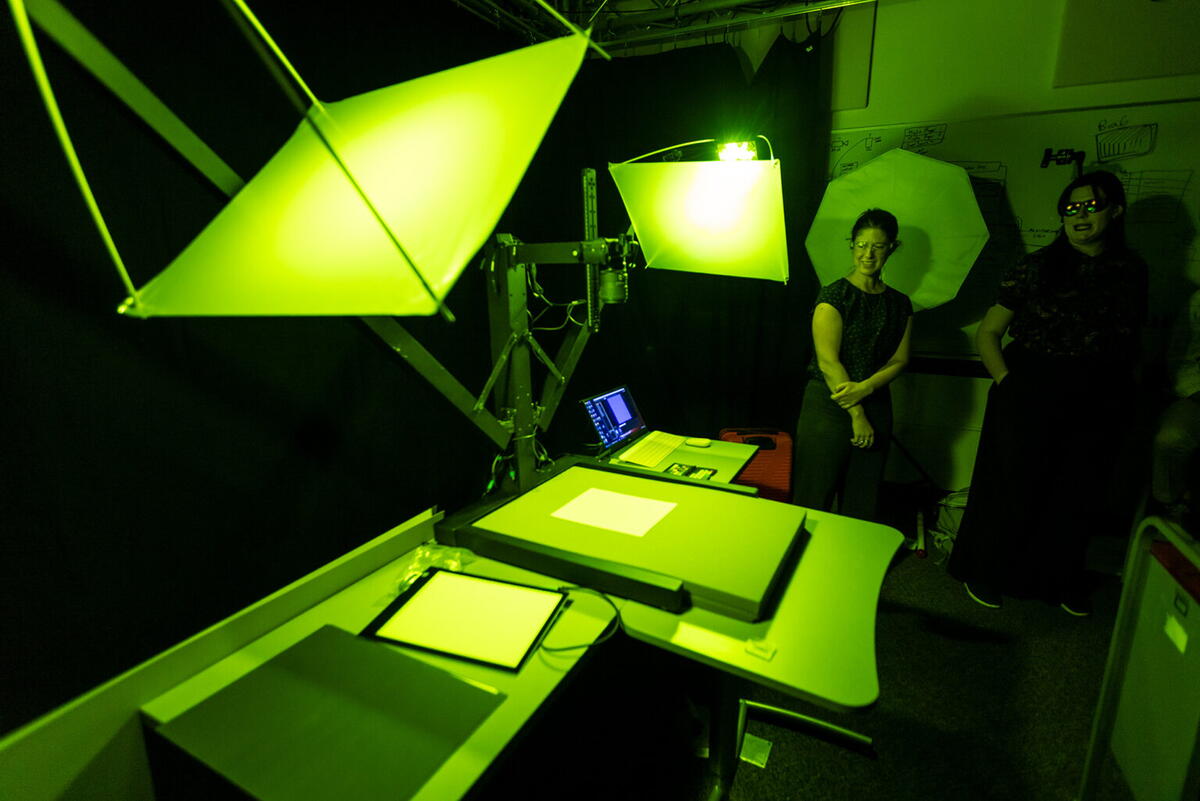
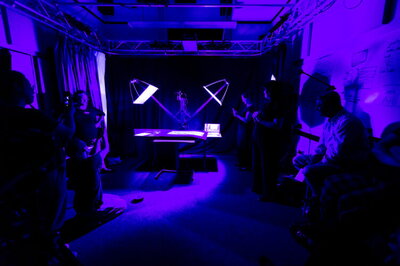
The spectral imaging system consists of a metal frame with an overhead camera and LED lights on either side set at 45-degree angles that illuminate an object in the center. Before the team began their work, all light sources in the room had to be covered. Black felt was taped over windows and the participants were asked to put away their cell phones so their light wouldn’t interfere with the imaging.
The team photographed the documents using various wavelengths of light through the visible spectrum, illuminating the object being photographed with a rainbow of colors, as well as infrared wavelengths. After the object was photographed, the team used machine learning to look at the images and select the areas with the greatest contrast, which were stitched together into a composite image that makes faint traces of ink more visible.
The parchment leaf and papyrus and other fragile items were imaged in their temperature- and humidity-controlled space within RBML. But the first few documents were imaged in a room next to the Library’s Media Commons.
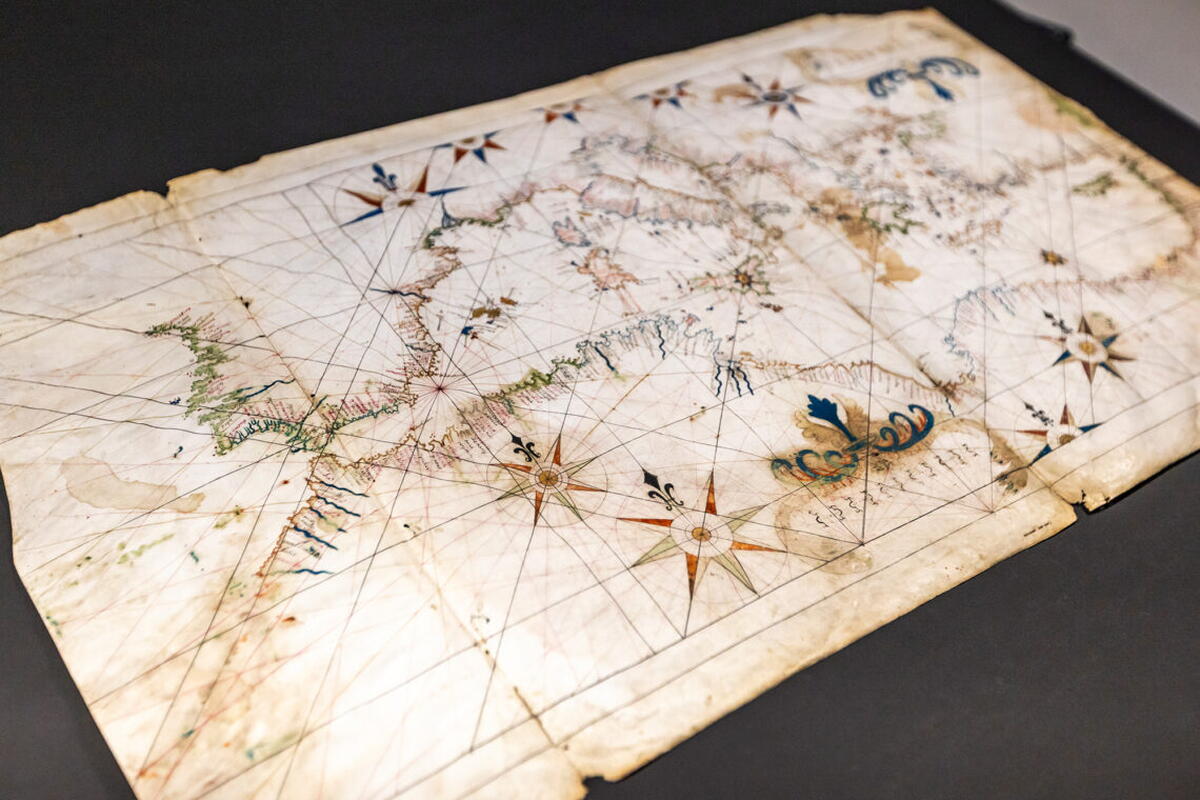
The first document that the team imaged was a Portolan chart published in Italy between 1530-1566 that mapped the entirety of the Mediterranean region. It is unknown whether the chart was brought to sea or whether it was documentary but not actually used for navigation. The chart includes compass roses, an accurate rendering of the coastline and cities accessible by sea. It has water damage on its edges, and if the imaging was able to find salt, it would be evidence that this chart might have been used at sea, Coker said.
The imaging also included:
- two Proust letters in the library’s Kolb-Proust Archive for Research that were written in light pencil and have become difficult to read;
- a page from a Sir Isaac Newton manuscript, a Latin translation of a French work on making the philosopher’s stone with notes on Newton’s own scientific work, to try to recover text that had been scratched and blotted out with ink;
- a 15th century collection of “Seneca’s Tragedies” that has several leaves in palimpsest, which is vellum originally used for other documents and then washed to be replaced with new text;
- the cover binding of a 16th century collection of “Orationes” that includes an outer cover of reused music manuscript and other material used as a backing to the cover that can’t be read without cutting open the book or using digital imaging. “You can see through the binding that there is formal text with marginalia. It’s just enough to tantalize you,” Coker said. “Being able to get a little bit of information about it is extremely exciting to help figure things out.”
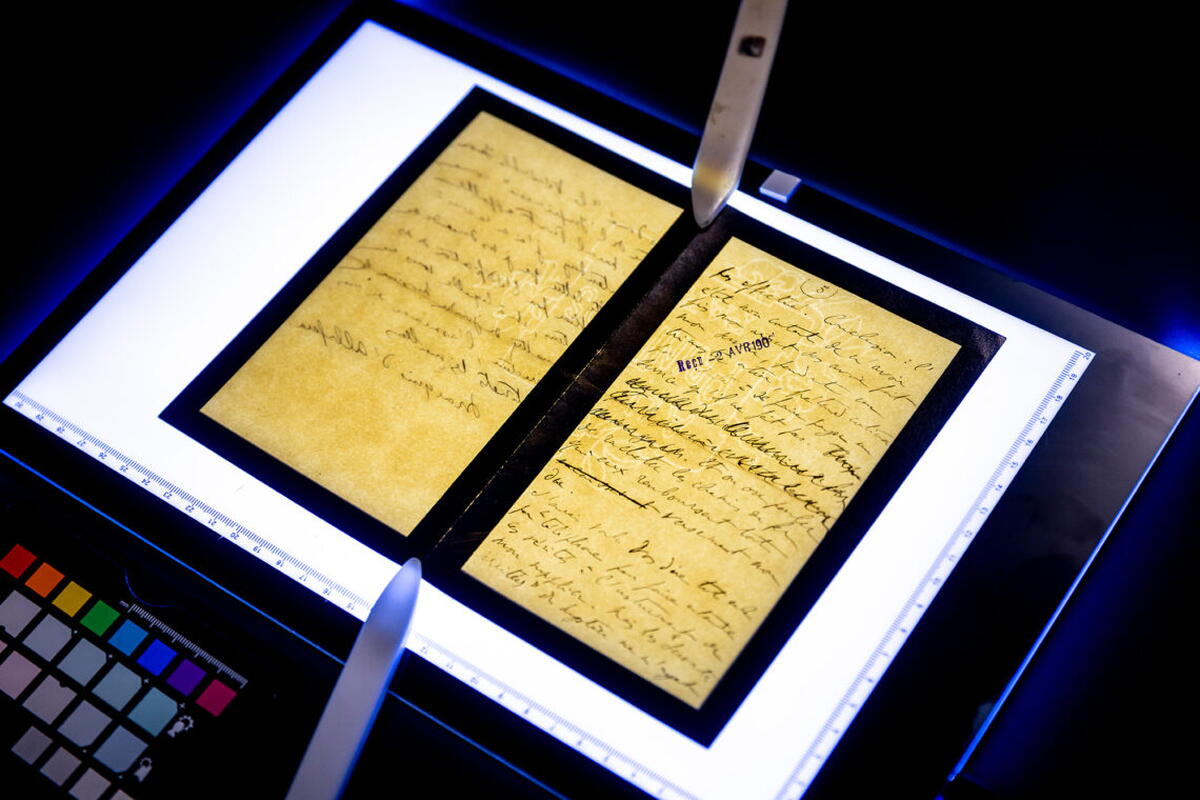
Seeing the text inside the “Orationes” binding was one of the most exciting developments of the workshop, Craig said.
“We haven’t yet transcribed or translated it, but literally no one has seen that text in years, much less been in a position to read it well enough to transcribe and translate it,” she said.
The final processing of the digital images and analysis of the resulting recovered text will take time to complete, Craig said, but based on a very early analysis of the raw digital imaging captures, it may be possible to revise the 6th or 7th century dating of the Greek papyrus.
In addition to helping the RBML learn more about some of its holdings, the workshop served as a proof-of-concept for the Videntes group to show what the imaging process can accomplish, she said.
Another aim of the workshop, Craig said, was to identify unique items in the RBML collection that can benefit from digital imaging and to increase public awareness of both the interesting documents in the collection and the ways in which research collaborations work across the campus and with other institutions.