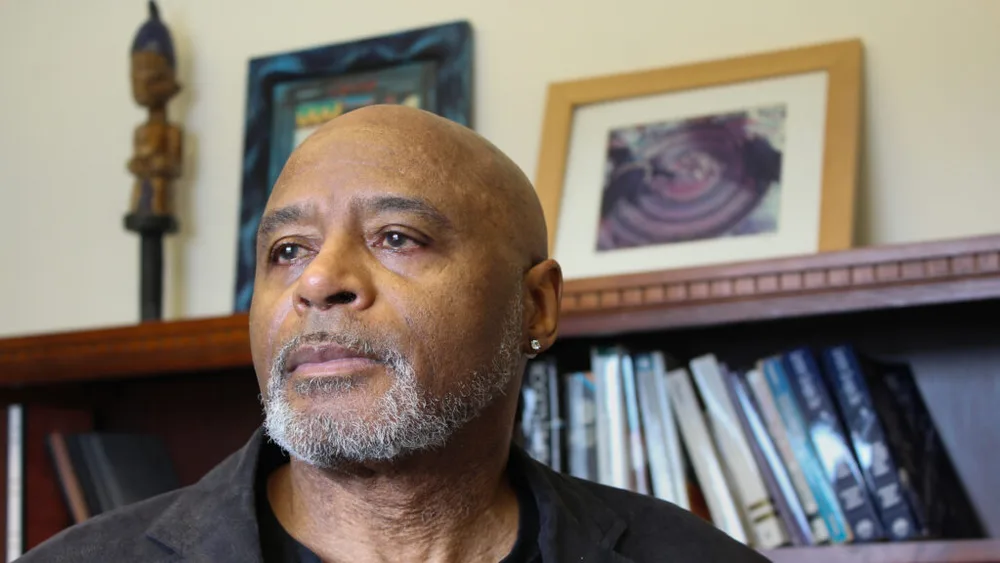
After 24 years of innovative teaching at the University of Illinois, emeritus professor Sundiata Keita Cha-Jua retired with honors in December 2025. Cha-Jua is a highly esteemed Black studies scholar-activist who dedicated his career tirelessly to the sociohistorical experience of African Americans, from 1619-present.
His areas of expertise include Black racial formations, African American historiography, African American community-building, radical Black intellectual traditions, the Black Liberation Movement, and culturally relevant pedagogical practices. Cha-Jua’s scholarship and organizing work alike have been recognized across North America, the Caribbean, Africa, Europe, and Asia. Cha-Jua’s impact on the fields of history and African American studies is nothing short of transformative—his goal was to build a sustainable path for liberation through the empowerment of studying and organizing Black people.
“I sum up my work by what I was able to produce,” Cha-Jua stated. “Creating curriculum, moving Black studies from a program to a department, and working and producing some outstanding doctoral students.”
Cha-Jua began his path to Black Liberation work as a teenager growing up in Decatur, Illinois. A highly gifted student, Cha-Jua used his love of reading and organizing to participate in local struggles for racial justice. This trajectory continued into his post-secondary education—he completed his bachelor’s in political science at Tougaloo College in 1977, his master’s in political studies at Sangamon State University in 1985, and his PhD in history at the University of Illinois in 1993.
Supervised by professor Juliet E.K. Walker, one of the foremost thinkers on the history of Black capitalism, Cha-Jua foregrounded his socioeconomic analysis in the power dynamics of Black community and institution building. His first book, America’s First Black Town: Brooklyn, Illinois, 1830-1915 (University of Illinois Press, 2000) established Cha-Jua as the foremost thinker on Black town-building and intraracial class conflict in the post Reconstruction Era.
In fact, Cha-Jua’s publication history demonstrates a dutiful eye to quality, rigorous, provocative, and pathbreaking research. For example, “A Warlike Demonstration: Legalism, Violent Self-Help, and Electoral Politics in Decatur, Illinois, 1894-1898" (2000) opened the door to a wave of scholarship on resistance to racial violence in U.S. cities. “The New Nadir: The Contemporary Black Racial Formation” (2010) recalibrated political economy as the core of the sociohistorical experience of African Americans. Finally, his co-authored article with professor Clarence Lang, “The Long Movement as Vampire: Temporal and Spatial Fallacies in Recent Black Freedom Studies” (2007), disrupted the Long Movement Thesis. The article established methodological frameworks for studying the Civil Rights Movement and Black Power Movement as separate, specifically defined eras with distinct goals, leadership, and symbols.
Additionally, Cha-Jua also authored Sankofa: Racial Formation and Transformation, Toward a Theory of African American History (2000), co-edited Race Struggles (2009) alongside Theodore Koditshek and Helen Neville, and co-edited Reparations and Reparatory Justice: Past, Present, and Future (2024) with Mary Frances Berry and V.P. Franklin.
Cha-Jua is also a beloved mentor to his students and is well-known for curating a kinship bond with his graduate advisees. In fact, over his career, Cha-Jua has advised 10 PhD students with most going on to national and international acclaim in research, teaching, publishing, professional service to the field, and activism. He has also served on the dissertation committees of over 30 PhD candidates and taught over 10,000 students in his undergraduate and graduate courses in over 30 years of teaching.
Cha-Jua rightfully understood the necessity of linking his scholarship to his activism against anti-Black racial oppression. Among his many roles in community organizing, he served on the executive board of the St. Louis-based Organization for Black Struggle, the National Council of the Black Radical Congress and on the National Council for Malcolm X Grassroots Movement.
Within academia, Cha-Jua built Black studies and history into powerhouses as often as possible. Throughout his career, he created 63 courses, a bachelor of arts degree, and a graduate concentration in African American studies. He also worked to build the two most critical journals in Black studies and African American history into stronger and more accessible publications. He served as senior editor of The Black Scholar (2011-2015), associate editor of the Journal of African American History (2015-2018), and a contributing editor on the Black Scholar (2005-2015) and on the editorial board of the Journal of African American Studies (2006-2014).
He also has taken on many leadership positions at the top of African American history and Black studies. He served as president of the National Council of Black Studies from 2010-2012 and 2012-2014. He also has served on the Association for the Study of African American Life & History executive council from 2016 to the present, and is a life member for both the National Council of Black Studies and the Association for the Study of African American Life & History.
Simply put, Cha-Jua’s legacy and profound success for decades lies in his commitment to people as people first. One of his former graduate students said “Sundiata invested in his graduate students—building classes that engaged us deeply in the scholarship, challenging us to put in the work for our research, and always connecting everything we did to the community and the pursuit of racial justice. Those of us who were lucky enough to work with him are better scholars—and better people—for our time together.”
Another former graduate student summed up Cha-Jua’s most critical characteristic best: “Beyond these academic relationships, lies a man that I truly respect and admire. Dr. Cha-Jua is an exceedingly kind person who takes a deep interest in my “real” life beyond my academic progress. He encourages his students to take time for themselves, have hobbies, and to care for their mind, body, and spirit, ensuring that they are wholly well.”
Augustus Wood (PhD, '20, history) is an assistant professor in the School of Labor and Employment Relations at the University of Illinois Urbana-Champaign.