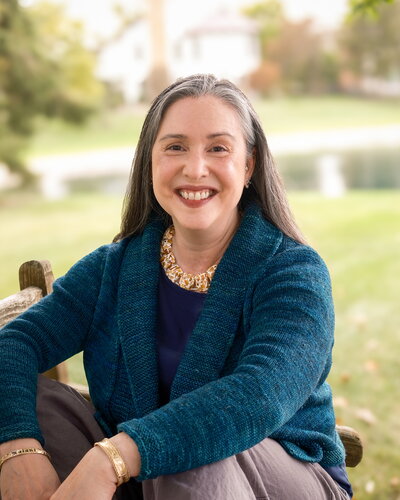
What if you could go on a medieval pilgrimage without ever leaving campus? That’s the idea behind professor Kalani Craig’s Virtual Medieval Pilgrimages (VMP) project, which was recently awarded the College of LAS Cohen Innovation Award.
Craig is a medievalist and digital historian who designs digital tools and platforms that can be used in research, classrooms, and communities. She wanted to create an opportunity for people to not just read about medieval pilgrimages but experience one for themselves.
Inspired by geocaching (a game where people find treasures at various GPS coordinates), Craig created a web-based app that maps pilgrimage sites from across the world onto physical locations on campus.
"I started thinking about what it would be like to find a treasure that's not physical. Pilgrimage is exactly that experience. When you go as a medieval person, you're going to find spiritual treasure or intellectual gains," said Craig. “There's all sorts of ways to get at these experiences people in the Middle Ages would have had by making people walk. Then they also get the contemplative nature of physical movement. They’re not just sitting and fiddling with their phones.”
How to go on a medieval pilgrimage
Users choose their pilgrimage based on an experience that interests them and receive coordinates to a location on campus. Once there, they receive information about the medieval pilgrimage site they're visiting.
There are six options including: travel a forest path, visit a famous healer, join a festival of nations, seek a wise counselor, falling waters mark a festival and the start of a pilgrimage, and venture into the depths of mother earth. She plans to keep adding more so users keep coming back for a new experience.
If you chose to visit a famous healer for example, you'd receive coordinates that might lead you to the student health center. Once there, you'd learn about a pilgrimage site like the Shrine of Saint Martin of Tours, that pilgrims would visit to be healed.
"A lot of the stories we hear in the medieval period are about healing saints. You go on a pilgrimage to the shrine of someone who heals people. You pray in front of their grave or in front of their relic and they heal you of your malady," she said.
In addition to healing, medieval people would also go on pilgrimages for religious or spiritual experiences, though sometimes it was just a good excuse to travel.
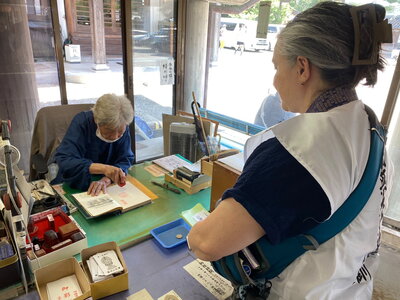
In medieval Japan for example, people would take up collections in their village to send one person on the Shikoku Pilgrimage (a trail of 88 Buddhist temples) as a representative because that was the only way to get a travel permit.
"One person would be the avatar of the village and they would take this religious pilgrimage as partially a pilgrimage for individual intellectual and spiritual enlightenment, but partially so that they could bring back souvenirs for their friends and family at home that represented where they had been. There's this really beautiful mix of reasons that people travel and mix of reasons that pilgrimage is a good reason for that travel to happen, that are both familiar to us and also very different than what we might experience. And being able to express that the past is an alien place in an embodied way is part of the goal," said Craig.
Expanding our ideas about the medieval world
Another goal of the project is to broaden people's ideas about the medieval world beyond Europe. Surprising users with the final destination, instead of letting them pick sites they've already heard of, has been a key way to create that engagement.
When Craig piloted the project, she also found that users became more invested when they learned about pilgrimages they'd never heard of before.
"We're showing them parallel and deeply different experiences around the world between 500 and 1500 when they wouldn't normally connect those places around the world to the idea of 'medieval'. Cahokia Mounds was the biggest city population-wise in the world in the 10th century, but most people think of London and Rome. And so, getting that into the puzzle is a big part of that ideological and geographic expansion of their ideas," said Craig.
Rollout and plans for future expansion
Craig hopes to launch the VMP project at a local arts festival sometime next year.
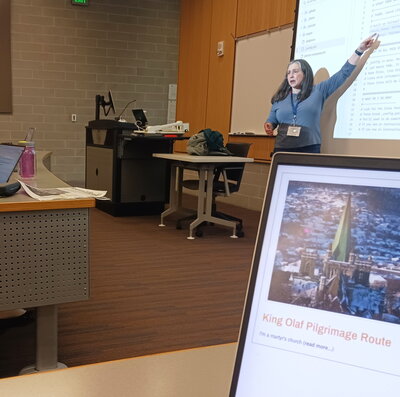
She's also working on creating a template version of the website so anyone can create their own without needing to know code. She piloted the template this past summer at a workshop at the Digital Medieval Studies Institute and several scholars have already adopted it in their classrooms and communities. Based on their feedback, she also plans to build a version for educators who want students to know in advance where they are going.
In the future, she plans to solicit contributions from academic experts about each pilgrimage that dive into topics like embodiment and the motivations of pilgrims. Those articles will be added to the app for users who want to go deeper. She also hopes to add virtual reality to each of the pilgrimage locations for users who aren't able to visit them in person.