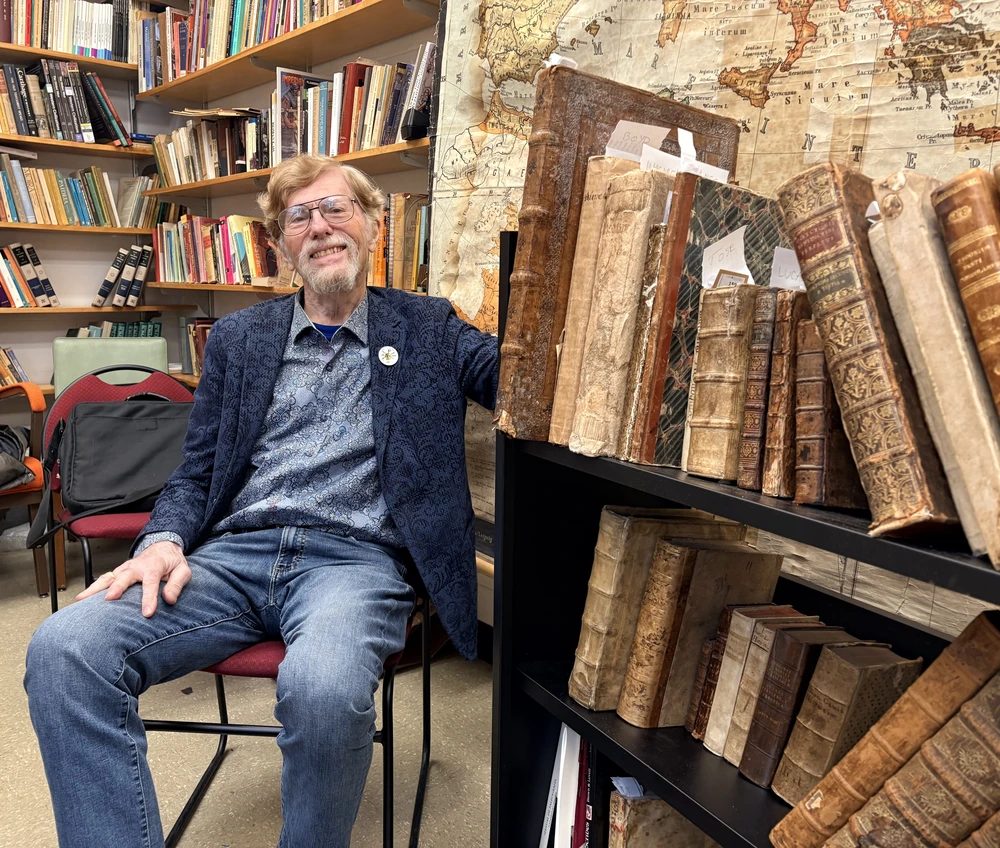
In August 1995, professor Ralph Mathisen was on a road trip from Vienna to Oxford when he took a spur of the moment detour that changed his life.
Shortly after crossing the border into Switzerland, he saw a sign pointing to St. Gallen, where the only known copies of the letters of Ruricius, Bishop of Limoges (ca. 485-510), were housed in the Stiftsbibliothek (Abbey Library) in a manuscript known as the Codex Sangallensis 190.
Mathisen didn’t know then that the Sangallensis contained the only surviving copies of letters written by religious leaders and two anonymous women in Southern Gaul (South France) during the late Roman Empire. But he had written about Ruricius’ letters in his dissertation and was intrigued by the opportunity to see them in person.
Making a decision that he describes as “brazen,” he showed up unannounced at the St. Gallen Stiftsbibliothek and began his 30-year journey to study the last letter collection assembled during European Late Antiquity.
He recently published the results of his research in a new book, The Codex Sangallensis 190 and the Preservation of Letter Collections in Gaul during Late Antiquity (Cambridge Scholars Publishing), which analyzes the text, but also studies it as a physical object.
Going beyond a strict textual analysis and studying the materiality of the manuscript—like the handwriting of the scribes, their marginalia and drawings, and how the manuscript was assembled—has given Mathisen a deeper understanding of the Sangallensis and fresh insights into its creation, its life, and the people who put it together. It’s also given him insights into the manuscript’s many mysteries.
The life of the Codex Sangallensis 190
The Sangallensis begins with hagiographical material (saints’ biographies) about St. John the Evangelist before the focus shifts to letters from religious leaders in Southern Gaul. In addition to the letters written by Ruricius and the anonymous women, it includes the only surviving copies of letters from leaders like Faustus, bishop of Riez (ca. 460-490), bishop Sidonius Apollinaris, bishop of Clermont (ca. 469-489), and Desiderius, bishop of Cahors (ca. 630-655).
During this era, Roman aristocrats and religious leaders exchanged letters across wide distances to share information and maintain friendships.
“Everybody was writing letters and lots of people had their letter collections. Which tell us a lot about personal life, about life on the ground,” said Mathisen.
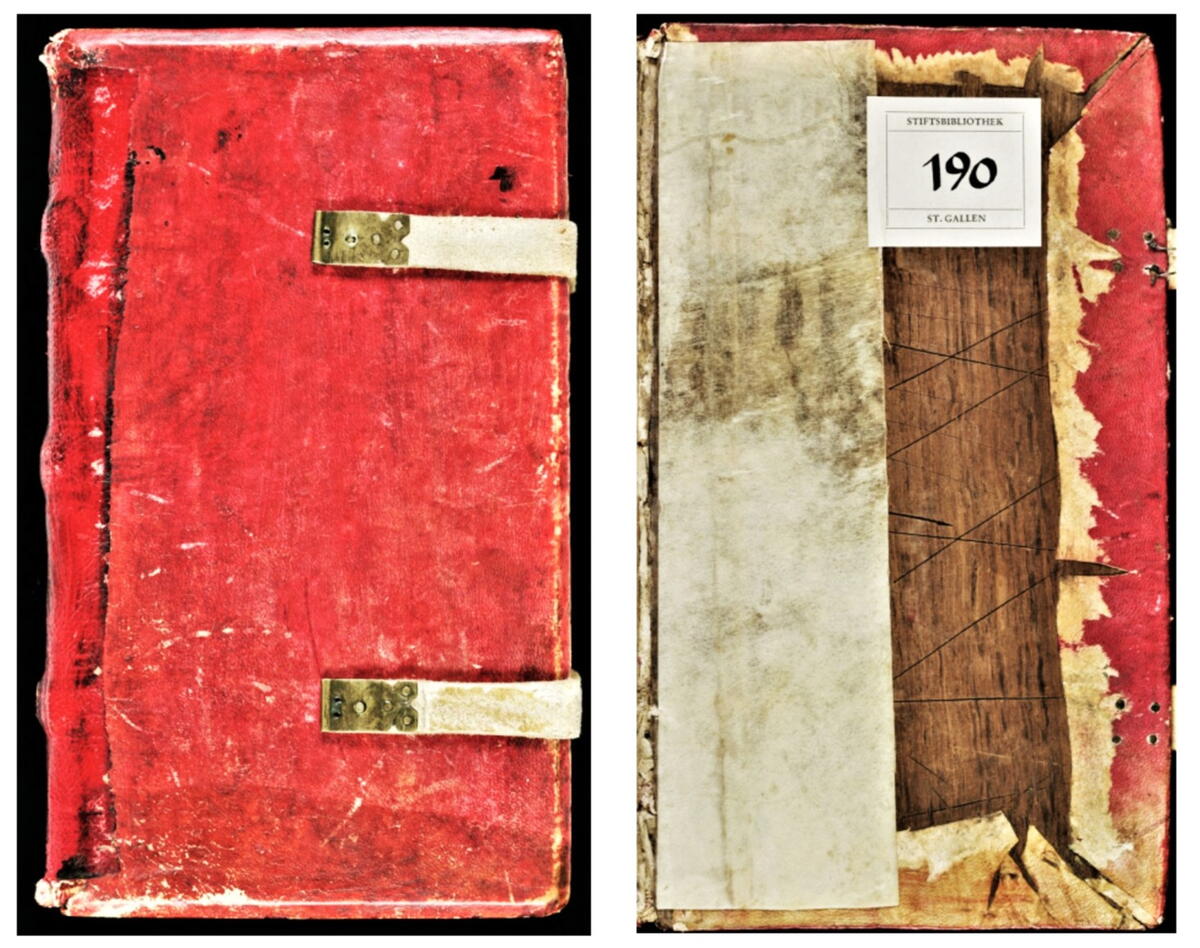
Copies of letters and documents from this period were often transcribed by monks at monasteries and collections, like the Sangallensis, would be created. Parchment would be assembled into four folded sheets to create gatherings that would be bound into a codex (manuscript in book form).
"Parchment was made from sheep or from calves. I mean, you could make it from cow skin, but that would be very, very thick and pretty tough. It was mostly from sheep. A big Bible could be 1000 sheep,” said Mathisen.
Historians don’t know exactly why the Sangallensis was created, but Mathisen argues that the emphasis on letters and the many rare works included indicate the compilers were intentionally creating a letter collection. He thinks it was put together around 800 CE, probably near the city of Cahors in southern France.
Many manuscripts from this period have been lost through time, which makes the Sangallensis rare.
“Most of the literary works that were made then don't survive,” said Mathisen. “Only occasionally do we find something where there’s only one copy that just survives by chance.”
Historians aren’t sure how the Sangallensis 190 eventually made its way from France to St. Gallen, Switzerland, but it wasn’t uncommon for monasteries to send manuscripts to each other. If it hadn’t been sent there, it likely would have been lost to history.
Letters between anonymous women
Women have a strong presence throughout the manuscript, which Mathisen thinks was intentional. In addition to the two letters from the anonymous women, the letter collections of Ruricius, Sidonius, and Desiderius contain letters written to women, and one of the addenda to the manuscript is a quote from a biography of Saint Radegund written by the seventh century nun Baudonivia.
In the letters exchanged between the anonymous women, an older woman who has adopted the religious life (which is similar to becoming a nun, though that’s a modern term), is encouraging a younger married woman to go on a religious retreat.
Earlier interpretations have understood the letters as a simple exchange between a mentor and acolyte (and have misattributed them to men despite the use of feminine pronouns and discussions of childbirth), but Mathisen argues there’s more to the interaction.
“I think the younger woman is humoring the older woman," he said. "She’s not interested in adopting that life. But she's [writing], 'oh yes ma'am, absolutely. Yeah, I agree. This is going to be really hard to do, though.’”
Mathisen has also written a forthcoming article on the letters between the two women, that contains a definitive translation, along with in-depth commentary and analysis.
The mystery of “the old monk”
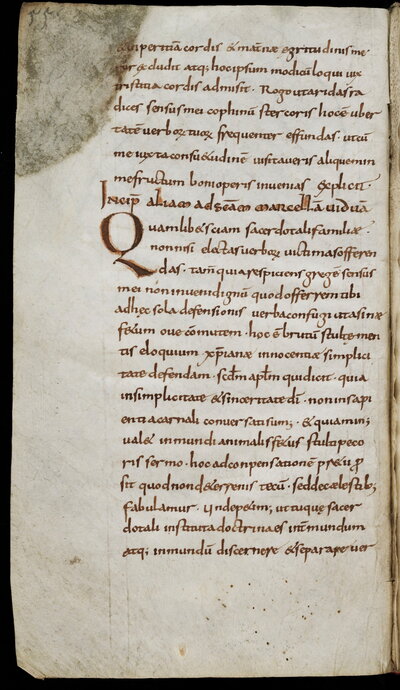
Using paleography (the study of ancient handwriting and scripts), Mathisen identified four main scribes who created the manuscript. One scribe in particular, whom he dubbed “the old monk,” copied the majority of the text. His script stands out because he added more flourishes, like drawing faces in his O's or transforming letters into birds. You also see spots where his script is correcting the work of others.
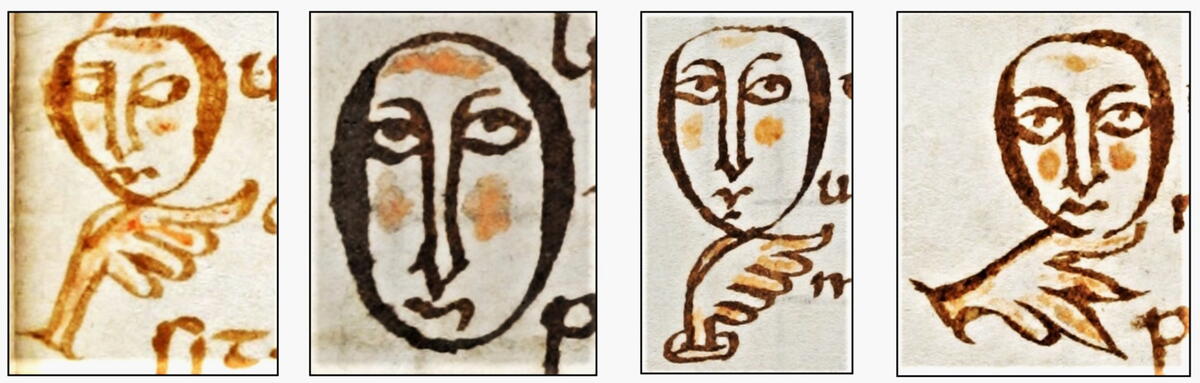
"The old monk” was heavily involved in the construction of the manuscript, serving as a copyist, illustrator, proof-reader, and commentator. Mathisen thinks his level of involvement fits the profile of a senior administrator or abbot rather than a low-level scribe.
One of the manuscript’s mysteries is a dedication on the first page to an abbot named Lando Vedeleobus. Historians haven’t been able to identify who he was, but Mathisen has a theory. Could he be “the old monk”? If he was the mysterious abbot and took an active role in creating a compilation dedicated to himself, it would make sense.
Mathisen also thinks “the old monk” had a connection to neighboring Visigothic Spain, based on the abbreviations he would use to make corrections in the margins. They were only used in texts from that region. This was also during a time when refugees were coming into Gaul from Spain. Could “the old monk” have been one of those refugees?
That “the old monk” was the abbot Lando Vedeleobus is a tentative theory, and more evidence will be needed to know for sure, but Mathisen’s discovery that he was connected to Visigothic Spain, “nails down” that the manuscript likely originated in Southern Gaul.
“If I hadn't waited 30 years to do this, I never would have discovered this,” said Mathisen. “Every time you go back to it, you see something new.”
The bee charmer
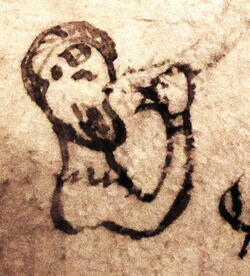
In addition to the annotations from “the old monk”, the manuscript also contains whimsical marginalia like what is likely a scribe’s self-portrait and a bee charm. The author of the charm wrote:
“The boy who blossomed here while he crafted a poem about bees,
famous and born full of celestial learning,
will not seek ‘the heights’ even if you wish to speak these words.”
Mathisen thinks it might have been written by a young scribe. There was an empty page, which were rarely left blank because paper was so valuable.
“This young man (obviously I think a young man) comes and writes this nice couplet in perfect hexameter saying basically, well, the bees might have flown away, but I'm not going to fly away. And then I think this is a little self-portrait. He's holding something. Not quite sure what it is. I think it might be the bees. He's holding his bees," said Mathisen.
Passing on the art of studying manuscripts
Mathisen is teaching students the art of studying manuscripts in a seminar this fall on the transition from manuscripts to printed texts. Contrary to popular belief, people still handwrote manuscripts for quite a while after the introduction of the printing press.
Each student is assigned a manuscript that he brings in from his own collection. He gives them a list of what to look for like the dimensions, paper type, binding type, and gatherings to understand how the text was put together. They also look at the different scripts used for headings and subheadings.
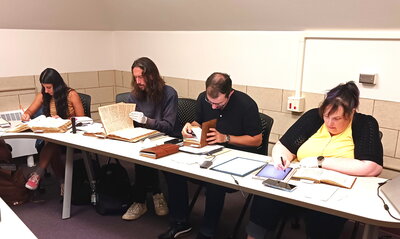
He teaches them to use tools like ultraviolet light, light tables, their own cameras, and even rulers to see hidden details. He’s found that students enjoy interacting with physical historical objects.
“Students like having the visual associated with the verbal, they can make that connection. And that's especially important when you're dealing with ancient or medieval history,” he said.
He hopes to teach students how to look at the wider context of manuscripts and their lives so they too can uncover their mysteries.