Q&A with professor Ralph Mathisen
May 28, 2026
Image

Image

What can barbarians and silver tell us about the end of the Roman Empire? Professor Ralph Mathisen, a historian of Late Antiquity, recently published a new book that explores the exchange of silver, both as coin and hacksilver, in the late Roman period between Romans and so called "barbarians." In Barbarians, Hoards, and Hacksilver in Late Antiquity: The New Silver Monetary Zone on Rome’s Northern Frontier he shows how the use of silver created a monetary zone across northern Europe that sustained trade, payments, and a smooth cultural transition into the early Middle Ages, instead of one fraught with conflict as is often depicted in pop culture.
He also co-edited a new edited collection that explores the use of prosopography, the study of how people interact in groups, in Roman history. It's a methodology that works well with digital databases and opens up new possibilities for understanding people and their relationships in Roman history. Brill’s Companion to Roman Prosopography, co-edited with Marietta Horster, Richard Flower, and Frédéric Hurlet, is the first and only existing comprehensive study of Roman prosopography and covers from the founding of Rome to the end of Late Antiquity.
Read on for a Q&A with Mathisen to learn more about both books and how they expand our understanding of the Roman Empire.
Image
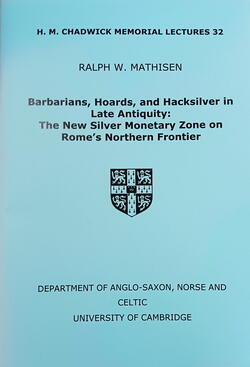
Who were the barbarians and what was their role in the late Roman period?
In modern popular culture, “barbarians” were savage northern invaders with horns on their helmets who beat down the gates of Rome, demolished the Roman Empire, destroyed the classical civilizations of antiquity, and created the “Dark Ages,” a period when the last flickers of ancient culture were preserved by a few monks snug in their monasteries. In reality, however, barbarians were rather different.
They were the peoples who lived just beyond the fringes of the Roman Empire, in places like modern Germany and Poland. They interacted with the Roman Empire for centuries. They regularly migrated into the Roman Empire, became Roman citizens, and adopted Roman culture at the same time that the Romans were adopting barbarian culture. Over the centuries a shared transnational culture developed in which “Romans” and “barbarians” looked very much alike.
In the late Roman period, beginning in the late third century CE, more and more of these barbarians were recruited into the Roman army, as both officers and men in the ranks. The empire became more and more militarized. During the fifth century, simply put, leaders of some of these barbarian contingents began to establish their own independent territories which gradually evolved into independent kingdoms. This did not happen, as popularly thought, because of catastrophic barbarian “invasions” but as an organic and generally peaceful process, given that these military bands already were part of the Roman army.
So if anything, the end of the western Roman empire resulted from a a series of military coups, but not from barbarian invasions. Which explains why the transition from the Roman Empire to so-called barbarian successor states happened so seamlessly and with so little actual military activity.
What role did silver and hacksilver play in the Roman empire’s relationship with Barbarians?
Treasure hoards from western Europe during the late Roman period sometimes include hacked-up pieces of Roman silver plate (plates, goblets, dishes, an so on). It once was thought that these pieces of “hack silver” resulted from barbarian raiders who hacked up their loot for division among themselves. But we now realize that something else was going on. The pieces often were hacked up to meet approximate weight standards, suggesting that they were meant to serve as currency, not as random loot. And this makes sense. The government of the western Roman Empire was increasingly strapped for cash. So much so, that generals could be reduced to chopping up pieces of Roman silver plate, of which there was an abundance, and using it as a form of currency pay to barbarian soldiers, whose love for silver was well known.
How does the trans-silver monetary zone that was created during this time help create a smooth transition into the early Middle Ages?
The silver monetary zone that extended from the northern part of the Roman Empire into “barbaricum,” the trans-frontier region occupied by barbarians, contradicts the traditional view that there were two different northern monetary zones in conflict with each other, that is, a “Roman” zone where currency was in the form of coined money, and a “barbarian” zone, where precious metals were traded by weight. The existence of this unified economic zone demonstrates that the relations among local peoples were based on cooperation rather than on conflict.
What is prosopography and how do you use it in your own research?
Image
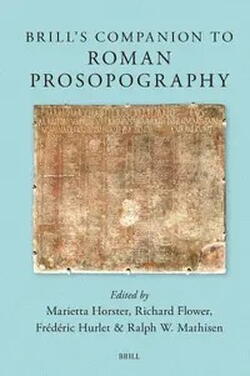
Prosopography, the study of how people interact in groups, is based on the assembling of massive amounts of standardized information, such as age, sex, place of origin, offices held, social class, and so on, about large numbers of individuals. I first put this methodology to work in my first book, Ecclesiastical Factionalism and Religious Controversy in Late Roman Gaul. Prosopography also is tailor made for the use of computerized databases and quantified analysis, another topic dear to my heart.
It was for this reason that during the 1990s I received five years of funding from the National Endowment for the Humanities to construct a massive database now containing over 27,000 individuals who lived during Late Antiquity. An example of how I put this database to use was when I used the evidence of nomenclature to demonstrate that it was in the period after the year 625 that bishops with barbarian names suddenly began to predominate in the Christian church in Gaul (modern France). It is not merely coincidence, I am sure, that this same period is thought to mark the end of Late Antiquity and the true beginning of the Medieval world. So here we have an example of how the conclusions reached by digital analysis can be shown to be consistent with and confirm the conclusions reached by the more traditional use of textual evidence.
How do digital methods open up new ways to use prosopography methods to study women and other marginalized groups?
Image
Unlike biography, which requires large amounts of detailed information about a particular individual, prosopography can be used to study categories of individuals whose personal histories are not that well known. This makes it ideal for the study of women and other marginalized groups, for the lack of information about particular well-known individuals can be compensated for by studying large numbers of individuals for whom not as much is known for each person.
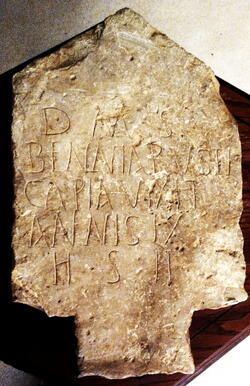
One spectacular way that this can be done is by studying inscriptions, documents written on stone, and in particular the epitaphs on tombstones. In antiquity, all categories and classes of individuals were commemorated on tombstones, men, women, and children; senators and slaves; soldiers and civilians. Hundreds of thousands of tombstones survive, and thousands of them are incorporated into my prosopographical database. Just like modern tombstones, they include a wealth of social information, such as name, gender, family members, age, birth and death dates, place of residence, and so on.
Like this epitaph of a Tunisian woman named Bennia Rustica, who “lived piously for sixty years,” that now is preserved in my living room. My student Kevin MacDonald, now in graduate school at Cornell, did an extensive prosopographical analysis of her and her suggested family members, attesting to how this kind of ancient material also can be used in the classroom.
By using digital methodologies to study these massive amounts of information, we can open up windows of insight into marginal groups that it would be impossible to do by simply working manually with traditional textual sources.
What possibilities do you hope the volume opens up for other scholars and our understanding of Roman history?
By clarifying just what prosopography is, how it can be applied, and different kinds of contexts in which it can be used, this volume not only will help to standardize the application of prosopographical methodologies so that all practitioners are working on the same page, so to speak, but also will, we hope, encourage larger numbers of scholars to put the methodology to work.