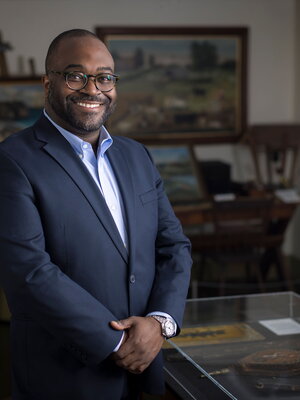
Meet Nile Blunt (PhD, '11, history), the newly appointed director of the Cahoon Museum of American Art. His research interests include European and American art and its interpretation across painting, the decorative arts, and material culture. He said his PhD provided him with versatile skills that have allowed him to work in diverse fields and shaped his commitment to making history and art accessible to diverse audiences. Read on for an interview with Dr. Blunt to learn more about his career.
Why did you choose the University of Illinois for your PhD?
I selected Illinois primarily to work with Professor Caroline Hibbard, a leading scholar of early Stuart Britain. Her research closely aligned with my interests in politics, religion, and court culture in seventeenth-century England. Additionally, I received a three-year fellowship as part of my funding package, which made the U of I particularly appealing.
What was the topic of your dissertation?
My dissertation examined the interplay among visual and material culture, ritual, religion, and politics at the court of King Charles I. I focused specifically on ceremonial dining, contending that it served both as a ceremony of state and as a form of religious ritual. I argued that analyzing dining and political culture alongside material culture and religious practice provided a new perspective on Charles I's approach to kingship and royal authority.
Can you tell us about your career path after getting your PhD?
After completing my PhD in 2011, I began teaching history and art history at Phillips Academy in Andover, Massachusetts. During my tenure, my responsibilities expanded to include museum and collection work, initially as curator of the school's Art & Antiques Collection and subsequently as curator of its historic map collection at the Addison Gallery of American Art.
These experiences led me to pursue museum work more extensively. I served as Head of School Programs at Crystal Bridges Museum of American Art, followed by the role of McPherson Director for Academic Programs at the Memorial Art Gallery at the University of Rochester, where I also held an appointment as Assistant Professor of Curatorial Practice in the Department of Art and Art History. In 2023, I joined the Museum of Fine Arts, Boston, as Senior Director of Museum Learning. In June 2026, I assumed the position of Executive Director at the Cahoon Museum of American Art on Cape Cod.
You've just been appointed as the executive director of the Cahoon Museum of American Art. What excites you about this new role?
I am most excited by the opportunity to help shape the museum’s next chapter. The museum possesses a distinctive history, strong relationships within Cape Cod, and a compelling combination of exhibitions, programs, and gardens. I believe there is significant potential to build upon these strengths to deepen the museum's role as a cultural anchor for Cape Cod, expand its reach throughout New England, and enhance its national presence.
How did your degree in history impact your life and career?
My degree in history has shaped my perspective on museums as spaces where research, education, and public service converge. It has informed my leadership by grounding decisions in evidence, curiosity, and a commitment to making history and art meaningful and accessible to diverse audiences.
What advice do you have for graduate students interested in pursuing work in a museum or jobs outside of a university?
The best advice I can offer is to be prepared to pivot. My career has demonstrated the versatility of skills gained through a history PhD. Although my specialization was early modern British history and my dissertation focused on the court of King Charles I, I now lead a museum of American art. My background in Atlantic history and research in visual and material culture offer valuable connections. However, it was my practical experience with objects, collections, and audiences that enabled me to work across various fields and disciplines.
What is your proudest achievement?
I am most proud of the opportunities I have had to create lasting initiatives, whether programs, partnerships, teams, or innovative approaches to work. The accomplishments that have been most meaningful to me are often not the most visible, but those that became embedded within an institution and continued to develop and to achieve further success after my direct involvement concluded.
To learn more about Dr. Blunt, you can find him on LinkedIn.