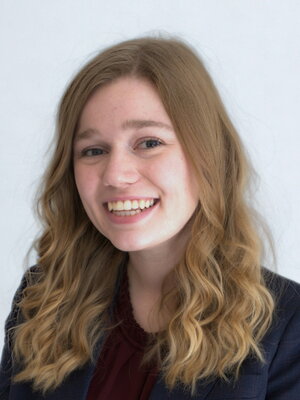
Meet Jensen Rehn (BA, '20, history), a litigation associate at Croke Fairchild Duarte & Beres. In addition to majoring in history at Illinois, she also completed a museum studies certificate in the anthropology department. After graduating, she earned her JD at Notre Dame Law School. She credits her history degree with teaching her critical thinking, reading, and research skills that prepared her for law school and her career.
Read on for a Q&A with Rehn to learn more about her career.
Why did you decide to pursue a degree in history?
My family went to the Galesburg Public Library every weekend throughout my childhood, and I loved checking out books about history. At one point in elementary school, I asked my dad a question about Galesburg. To help me find the answer, he took me to the town archives where we learned how to use microfilm together. I was hooked! Incredible teachers encouraged my interests, so I knew I wanted to study history in college. Studying history at Illinois combined the resources of a major research institution—including one of the best library systems in the world—with small class sizes in Gregory Hall.
Did you pursue additional higher education after undergrad?
I started at Notre Dame Law School the fall after I graduated from the University of Illinois. Studying history prepared me well for law school. I felt comfortable reading dense cases and making arguments based on the presence or absence of words in a particular text. Thinking critically about primary source materials and how people engage with them is a skill I developed at Illinois. As I annotated law school readings, I thought about when statutes were enacted and who brought the lawsuits that led to the opinions we read. In legal research classes I asked law librarians how legal databases catalog and tag cases. The practice of questioning encouraged in the history department served as an asset in law school.
What was your first job after college?
During law school I worked as a research assistant for several law professors and in the Kresge Law Library. I worked shifts at the circulation desk, helped law librarians put together library guides, and collected information about materials in Kresge’s manuscript collection. Some of my work also included cite checking, so the familiarity I developed with the Chicago Manual of Style as a history student helped, too!
What is your current career and how does your degree in history inform your work?
I am a litigation associate at Croke Fairchild Duarte & Beres. As a history student, I spent most of my time reading, researching, and writing. As a litigation associate, I spend most of my time doing the same three things.
What do you enjoy about your work?
I love so many parts of my job! First, I enjoy learning the facts for each case. My firm works on a wide variety of matters, so I am always learning about new subject areas. Once I understand the facts, I love finding answers to procedural questions. Using the Federal Rules of Civil Procedure feels like a puzzle to me, and I enjoy thinking through different ways to fit the pieces together.
What does a typical workday look like for you? Also, what is an example of the most interesting aspect of your job?
No two days look the same. Even if I need to draft two motions to dismiss, differences in the facts of each case make the experiences unique. The most interesting aspects of my job are conversations I have with clients and other attorneys. Hearing how someone else thinks about the facts of a case or the elements of a claim leads to better research questions and stronger writing.
What advice do you have for students interested in pursuing work in your field?
Don’t think that you need to follow a specific path if you want to eventually become a lawyer. For example, I worked in the Rare Book and Manuscript Library as an undergraduate, which did not relate to law but was the highlight of my time at Illinois. Ultimately, spending time with librarians inspired the piece I published in the Notre Dame Law Review about the First Amendment and public school libraries. Also, take advantage of opportunities to explore your interests. Go see speakers who come to campus. Meet up with friends at an exhibit opening. Take a class that seems completely random. To navigate the stress of law school and working as an attorney, it helps to continuously cultivate your interests. Build that habit now as an undergraduate so you can carry it forward in your career.
What is your proudest achievement?
Clerking for Judge Charles R. Wilson on the United States Court of Appeals for the Eleventh Circuit and Judge Lindsay C. Jenkins on the United States District Court for the Northern District of Illinois. I am so grateful to have started my legal career working for such thoughtful jurists and wonderful people.