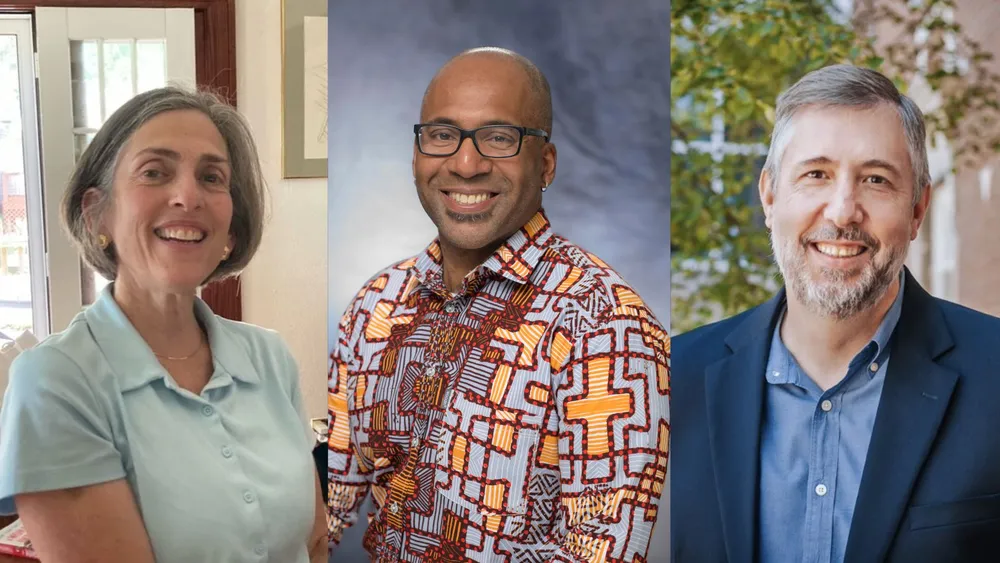
History professors Dana Rabin, Erik McDuffie and Jerry Dávila, have recently taken on leadership positions in the Program in Jewish Culture & Society, Center for African Studies, and Humanities Research Institute. They join fellow history faculty Carol Symes (Director of the Program in Medieval Studies) and Robert Morrissey (Associate Dean for Technology and Online Learning in the College of LAS) in providing leadership on campus.

Dana Rabin, Director of the Program in Jewish Culture & Society
This fall, Rabin succeeds Tobor Family Endowed Professor of Modern European Jewish History Eugene M. Avrutin as Director of the Program in Jewish Culture & Society.
She specializes in the history of law, gender, and race in eighteenth century Britain. She's the author of Identity, Crime and Legal Responsibility in Eighteenth-Century England (Palgrave) and Britain and its Internal Outsiders, 1750-1800: Under Rule of Law (Manchester University Press).
Her latest research examines Jewish life in the Caribbean during 1780-1830—a period that saw the abolition of the slave trade and the emancipation of enslaved people. She's exploring the relationship between Jewish communities, enslaved and freed people of color, colonial and metropolitan authorities, and surrounding white Christian populations to understand how Jewish communities built relationships across the Jewish Atlantic, how race and faith intersected during this period, and how definitions of families were shaped during this turbulent period of change.
"My goal as director is to build community within Jewish Studies and across campus," she said. "By talking with one another about our research and teaching, engaging the public whenever possible, and facing the difficult conversations of our time, I hope to bring people together with experts in the field to navigate the challenges we face in ongoing dialogue."
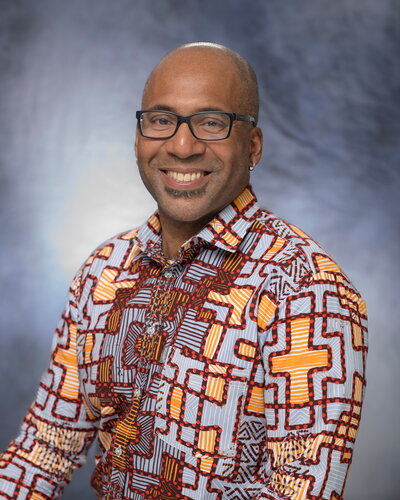
Erik McDuffie, Director of the Center for African Studies
Last fall, McDuffie succeeded professor Teresa Barnes as Director of the Center for African Studies.
McDuffie is a professor of history and African American Studies. His research interests include Black movements, Black feminisms, Black (inter)nationalism, the Midwest, gender, sexualities, urban history, and Global Africa.
He is the author of The Second Battle for Africa: Garveyism, the US Heartland, and Global Black Freedom (Duke University Press) and Sojourning for Freedom: Black Women, American Communism, and the Making of Black Left Feminism (Duke University Press).
He's currently working on two books. The first book, In Search of Freedom: The Global Journeys of Black Ohio Abolitionists John and Frances Hatfield, establishes the importance of the U.S. Midwest to nineteenth-century global Black history and traces the understudied linkages among the US heartland, Canada, Australia, Oceania, the Atlantic world, and the African world, through his ancestors. The second monograph, Decision in Africa: W. Alphaeus and Dorothy Hunton and Possible Global Black Futures, explores the power and possibilities of African and African diasporic history for advancing and imagining global African liberation through the work and global travels of mid-twentieth-century African American radical interationalists W. Alphaeus and Dorothy Hunton.
"Africa is not the future. Africa is now. This perspective guides my leadership of the Center for African Studies," said McDuffie. "We are committed to advancing innovative, impactful, and socially responsible scholarship, teaching, and engagement related to Africa and its global diaspora on campus and beyond. I am honored to serve as CAS Director and to fulfill our mission."

Jerry Dávila, Director of the Humanities Research Institute
This fall, Dávila succeeds Swanlund Endowed Professor Antoinette Burton as Director of the Humanities Research Institute.
Dávila is a historian of Latin American history. He holds the Jorge Paulo Lemann Chair in Brazilian History and previously served as the executive director of the Illinois Global Institute.
Dávila’s research focuses on the role of racial thought in public policy in Brazil and on the relationship between states and social movements in the twentieth century. He is the author or co-author of numerous books, including Diploma of Whiteness: Race and Social Policy in Brazil, 1917–1945; Hotel Trópico: Brazil and the Challenge of African Decolonization; Dictatorship in South America; and A History of World Societies.
“The challenges our society and world face call on the humanities to envision just and inclusive futures,” said Dávila. “I am honored to lead HRI and to support the extraordinary community of humanists, artists, and social scientists at Illinois whose work is at the forefront of our understanding of human experience and possibility.”