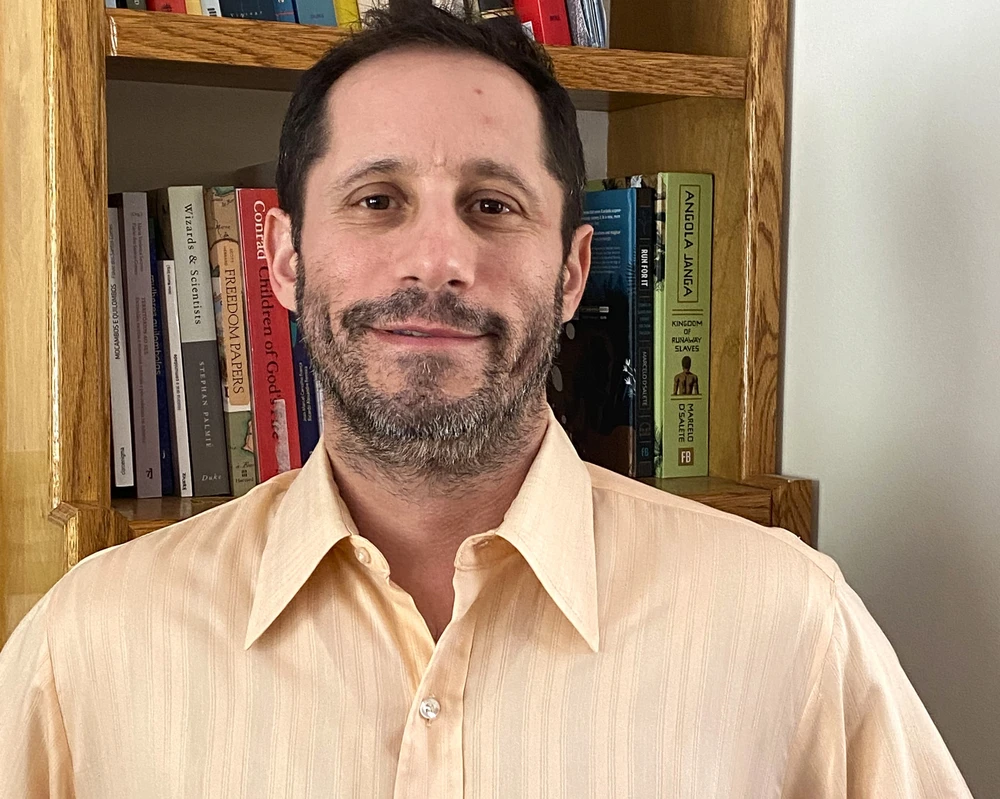
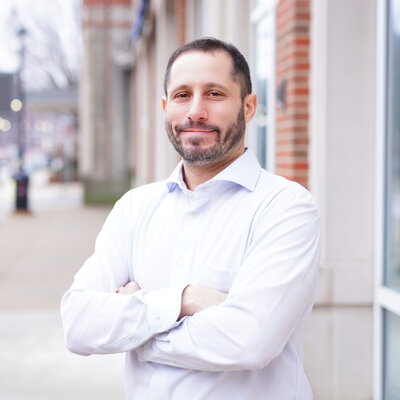
There was a moment in graduate school for professor Marc Hertzman when he didn’t think he would finish. He had one final essay to write for his preliminary exams that was due that afternoon, but he found himself completely stuck. He had to teach that morning and went into the classroom thinking it would be for the last time. Instead, the students lifted him up and gave him the energy he needed to write the essay and turn it in just in time.
Hertzman’s been thinking a lot about that moment lately and about the value of the connection students and teachers form in the classroom. He’s a passionate teacher and has been recognized for it by receiving the 2026 LAS Dean’s Award for Excellence in Undergraduate Teaching, the campus 2026 Excellence in Undergraduate Teaching Award and Department of History 2024 George S. & Gladys W. Queen Excellence in Teaching Award.
“Without his help, I don't think I would have been admitted to any PhD history programs. He taught me how to be a better writer, a better researcher, a better historian, and, most importantly, a better person,” wrote a former student.
Hertzman, a historian of Brazil and Latin America, teaches courses on Black music and Latin American history. One of the fundamental things he tries to teach his students is empathy, which he sees as crucial to understanding history.
“Empathy to me is one of the key things that we do as historians. Because to understand how people who we've never met, travel through this world, we need empathy,” said Hertzman.
To do this, he encourages students to connect with historical events personally. When teaching students about slavery for example, he asks them to close their eyes and imagine a loved one that they’ve lost. After a minute or two, he asks them to try to apply those same feelings to the incomprehensible magnitude of the lives lost to slavery.
“I try to get them to think about their own lives and the people who are close to them, so if they're not actually relating to someone from 200 years ago, they're at least thinking about this in very human and intimate terms,” he said.
Understanding the history of Black Music
Hertzman teaches one of the department's most popular courses, HIST 104: Black Music, which he’s taught since he was a post-doctoral fellow at Wesleyan University nearly twenty years ago. Each unit of the course is organized around a concept, like the Prison Industrial Complex, and explores related albums by Black artists.
For example, he uses Beyoncé’s visual album Lemonade to talk about intersectionality and how Black women have to navigate both racism and misogyny. He finds that using something familiar to students helps them understand the material better.
“Everybody has something to say about music. I try to engage students where they're at and bring them in with something that's interesting to them because I think they do better work and they actually can get excited,” he said.
Though the course is now taught online with in-person discussion sections led by teaching assistants, Hertzman hopes to teach an in-person version again after he returns from sabbatical next year. He misses connecting with students over the course material. Though he still has independent study students and often observes sections. Referencing a meeting with an independent study student who is painting album covers for her favorite artists he wrote:
“That meeting gave me energy as did observing Andrew Thomas teach a brilliant section of HIST 104 later in the afternoon. He delivered an incredible presentation about race, racism, and music. I left both the independent-study meeting and Andrew's section feeling that same energy that my students back in graduate school gave me that day I finished my pre-lim exams.”
Connecting the past and present
Unlike Black music, students who come to his Latin American history courses are less familiar with the topic. He tries to help them understand how the region fits into larger historical events like slavery, and the role the United States has played in the region.
In January 2023, when a mob of supporters of former Brazilian president Jair Bolsonaro attacked federal buildings in Brasília following his defeat in the 2022 elections, Hertzman completely redid his course on Brazil. He wanted students to understand the events in relation to the similar attack in the United States on January 6, 2021. Helping students understand the connections between the past and the present is a key part of being a historian for Hertzman.
“One of the things that I think is really powerful and exciting is when students can come into a class and not know anything about Latin America, this distant place and distant time, and be able to travel there with imagination and resources. And so being able to connect the past and the present to impart that we can't understand the world today, we can't make the world today however we want it to look without understanding how we got here,” he said.
He also uses his own family history to show students how we are connected to historical events that feel distant. One day, he will wear a shirt to class that belonged to his great-grandfather, who was born in 1885. He then walks students through the timeline of slavery and abolition in the Americas.
“So I show this shirt I'm wearing, and that the man whose shirt this was, was born into a world where slavery still existed,” he said. “Part of what I try to do then is show through family history, through memory, and through even an object, we are a lot more connected to this time and space that feels so far off.”
Hertzman is the grandson of Sydney and Sadelle Berger, who were activists in Evansville, Indiana. His grandfather gave him the shirt, and their legacy has shaped his work as a historian and teacher. He wants students to know the power of speaking up for their values.
“There are a lot of chapters in history and people who have done amazing things that I draw inspiration from and I try to pass that along to students, to show if you speak up and have your voice heard, even in the face of everything, of overwhelming odds, of an impossible situation, speaking up and having your voice heard can be something really powerful,” he said.