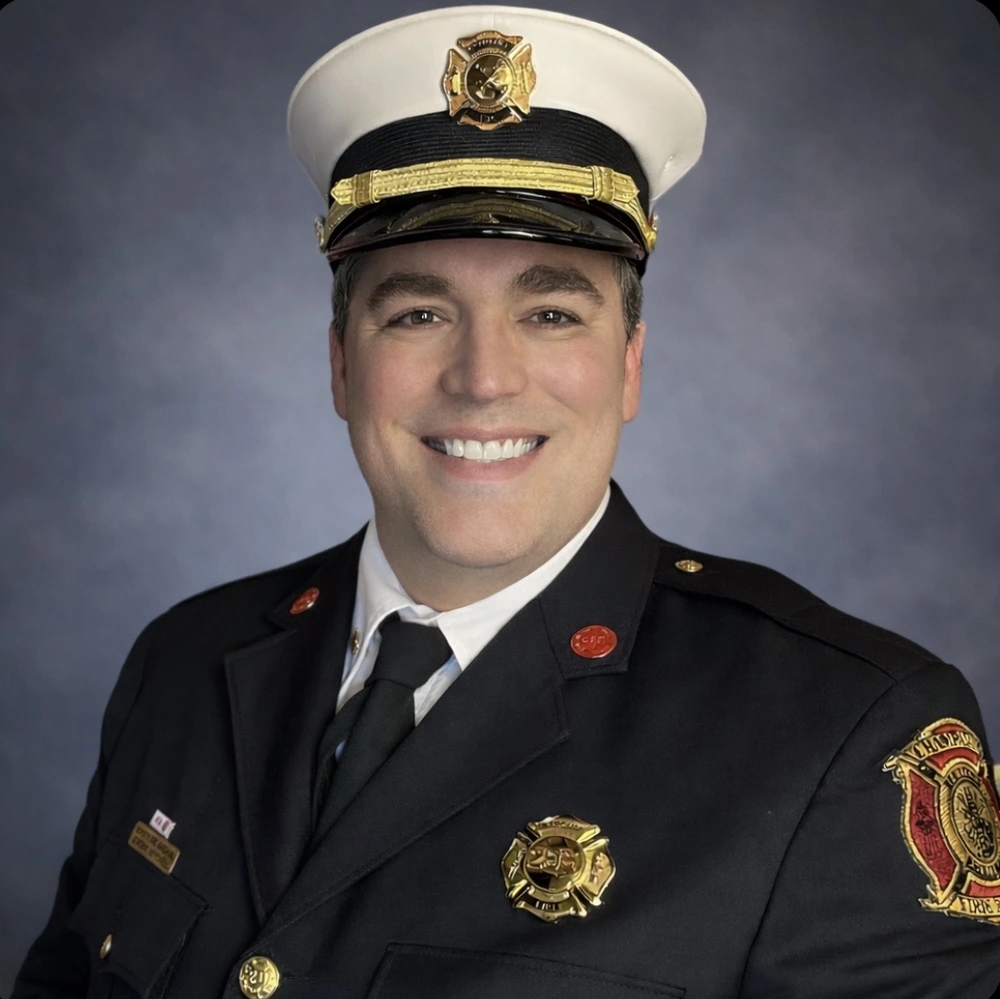
Meet Jeremy Mitchell, (BA, '02, history), the Deputy Fire Marshal in the Life Safety Division at the City of Champaign Fire Department. Mitchell majored in history with a specialization in European and military history and earned a master's degree in public administration with a concentration in disaster management from American Military University.
He credits his history degree with teaching him critical research and data analysis skills as well as the ability to synthesize large quantities of information into actionable insights. He also learned cultural competency skills that he leverages to build trust and create solutions for all communities in Champaign.
Read on for a Q&A with Mitchell to learn more about his career.
Why did you decide to pursue a degree in history?
I spent my first semester as a pre-med student; as the first member of my working-class Midwestern family to attend a major university there was tremendous pressure to “shoot for the stars,” but I didn’t enjoy my time in that program. I decided that if I was going to remain at the U of I it would be on my own terms. I grew up reading Tom Clancy’s Jack Ryan novels, and rather than all the military hardware and thriller plots what stuck with me was how the character’s background in history enabled him to pursue many different career paths that he enjoyed. To the chagrin of my family, I changed my major to history and my first non-survey history course was John Lynn’s “War, Military Institutions, and Society Since 1815.” I was the only freshman, and when our final papers were graded mine was among very few A’s. I later learned that professor Lynn rarely gave A’s, and never to freshmen, so I felt very confident and happy that I had found my place.
Did you pursue additional higher education after undergrad?
In 2011 I earned my Master of Public Administration with a concentration in Disaster Management from American Military University. By that time, I was working as a firefighter with an eye toward moving up the ladder, and advanced degrees were becoming the baseline for appointment as chief fire officers—after I completed mine, I tutored my father, who retired from our fire department as a deputy chief.
The MPA is the de rigueur advanced degree in the fire service, but I approached the program with a historian’s perspective. As an undergraduate I mostly studied the interplay of institutions at the national or international level, but working as a local government employee on a very busy heavy rescue vehicle gave me a firsthand perspective on how culture, economy, recent and past history, and social and governmental institutions interact to create the living environment we all share. I became very interested in the history of American cities, why some prospered and some struggled, and how those historical events informed how we create safe, happy, and healthy cities for the citizens we serve. And, of course, coming from a history background I had no fear of the research and writing required of a master’s program; I actually wound up spending a semester as a research assistant and seeing my name attached to an academic paper helped me “catch the bug,” and I’m somewhat of a known author in my field now.
What was your first job after college?
My first job after college was serving as a firefighter with the City of Galesburg Fire Department in Western Illinois; in addition to being a “townie,” my family worked primarily in public safety. My grandfather was a University police officer, and my father retired as a deputy chief at Champaign Fire. My uncle was a battalion chief when the University had its own fire department, and after UIFD was discontinued he became the Urbana Fire Department’s fire marshal for campus. I’m not necessarily proud of it, but I would sometimes skip class to accompany him on fire inspections and investigations, which prompted my interest in what I’m doing now. I joke that the U of I prepared me for my career, just not always in ways they probably intended.
What is your current career and how does your degree in history inform your work?
This month I am completing my twentieth year of service with the City of Champaign Fire Department, where I am a captain assigned to the Life Safety Division as a Deputy Fire Marshal. For a fire department serving a “big, small town” like Champaign, being a fire marshal encompasses many tasks. Among mine, I am our community risk reduction program manager, GIS program lead, data analyst, and one of our primary fire investigators. My history degree is particularly helpful in the areas of community risk reduction and in data analysis; for the former, CRR is about creating and implementing life safety interventions considering the particular characteristics or circumstances of different populations. Even in a small place like Champaign, we are a community of communities, and understanding how they came to be and leveraging cultural competency to create a mutually trusting atmosphere helps me better prevent emergencies for those citizens. Also, having a strong background in research makes me uniquely positioned in our fire department to work well with large data sets, identify trends, and generate actionable insights that enable the Fire Department to agilely tailor our service delivery package to what’s happening in Champaign right now.
What do you enjoy about your work?
I was once introduced at a professional conference as, “This is Jeremy. He sees the Matrix,” and while it was meant as a joke, there is a kernel of truth to it. I truly enjoy when I am able to blend research, data analysis, and predictive modeling so that the Fire Department is ahead of the curve when it comes to confronting risk and protecting our citizens. I really believe that doing the work I do now I’m putting out more fires than I ever did riding around on a fire engine.
What does a typical workday look like for you? What is an example of the most interesting aspect of your job?
Currently, the Champaign Fire Department is pursuing accreditation status through the Center for Public Safety Excellence; this is a three-year process, and I am our accreditation manager. The first step toward accreditation is the development of a Community Risk Assessment and Standard of Cover; this will be an approximately 150-page document that describes physical attributes of the city, different community vulnerabilities, and how the Fire Department will acquire and allocate different resources to protect our citizens. Again, I am uniquely suited to this task owing to my academic background, but there is added pressure in that this document helps create what the Fire Department will be in the future. Bad data practices, sloppy research, and drawing the wrong conclusions could adversely impact the Fire Department and the city for years to come, so a goodly portion of my time currently is spent on this document. I am also always on call to respond to structure fires to investigate their causes, and perform plan reviews of blueprints submitted for fire protection systems in new buildings. As we move into spring and summer, my days will be filled more with delivering fire and life safety education to elementary schools, as well as staffing community events where Fire Department participation is requested.
What advice do you have for students interested in pursuing work in your field?
Firefighters riding on fire engines is obviously the most public-facing aspect of the fire service—and to be honest in your twenties it’s tremendous fun—but there is room in the Fire Department for people with varied interests and skills. Your education in history helps you develop perspective and empathy which helps you interact with and serve many different population groups across our job types. Skills such as research, report writing, data analysis, and being able to synthesize and visualize that data to guide decision making at higher levels are lately being recognized as important in the fire service, but they are not skills native to traditional fire service training. Additionally, if you’ve given any thought to teaching, the ability to stand in front of an audience and engage them in a way that is interesting and informative is a great help in the delivery of risk reduction services. Your history education is broadly applicable to many areas in which we need people, so mostly I would encourage undergraduates to develop that wider perspective when considering careers.
What is your proudest achievement?
I am a credentialed fire marshal and fire and emergency services analyst through the Center for Public Safety Excellence; for the former, only about 10% of fire marshals in the United States are credentialed, and for the latter there are fewer than 200 credentialed fire and emergency services analysts. I am also a member of the Institution of Fire Engineers Champions and Emerging Leaders in Community Risk Reduction advisory board, so I would have to say that for me it’s not enough to be in a career that I love and that I take a particular pride in being a trailblazer.