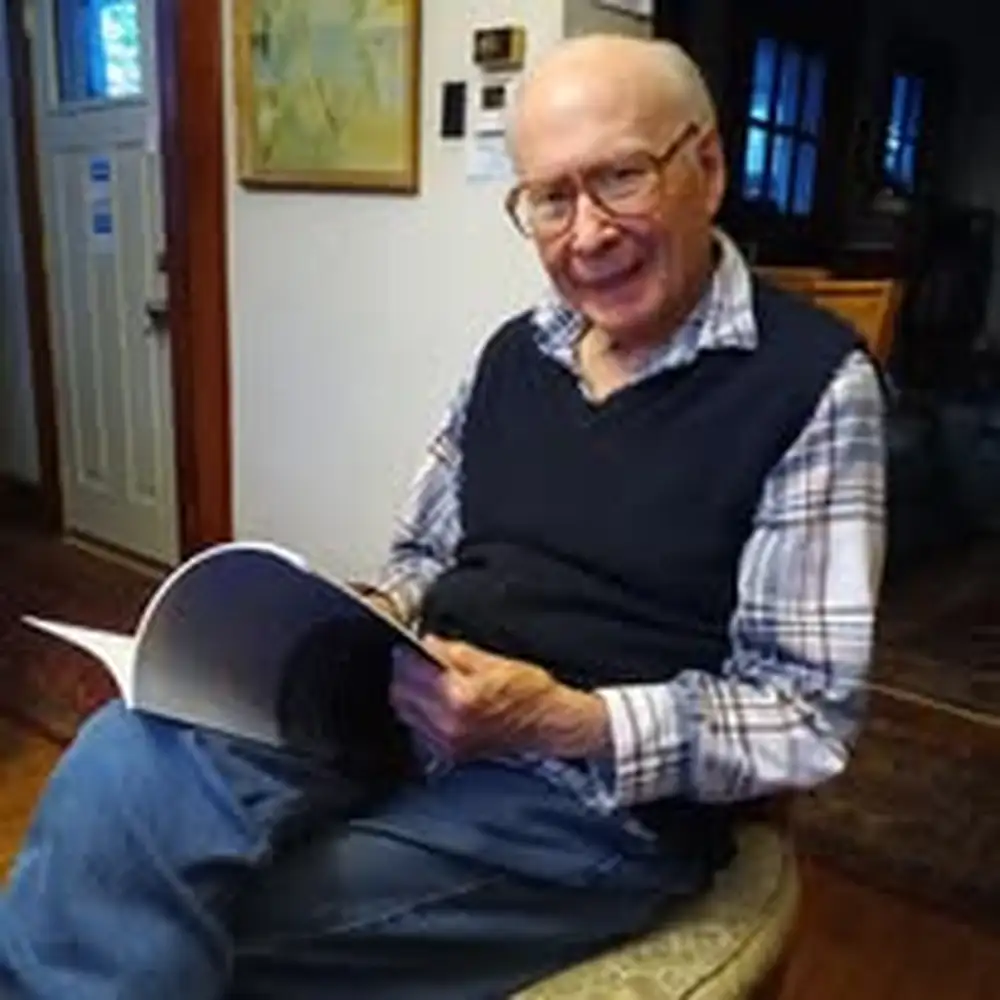
Emeritus professor Robert McColley passed away in December 2025. McColley specialized in the history of the United States from the American Revolution through the Age of Jackson. He joined the Department of History in 1960, after earning his PhD from the University of California Berkeley, and retired in 1997. He served as the president of the Illinois State Historical Society in the late nineties and was editor of the Journal of the Illinois State Historical Society from 1998-2002. He was the author of several books including Slavery and Jeffersonian Virginia (1964), Federalists, Republicans, and Foreign Entanglements (1969), and editor of a critical edition of John Randolph by Henry Adams (1996).
He was a dedicated teacher who mentored students and young scholars on their path to become historians. Three historians, alumnus Don Hickey (BA, 62; MA, ’68; PhD, ’72; history) an emeritus professor at Wayne State College, Douglas Egerton, a professor at Le Moyne College, and alumnus Christopher J. Young (BA, history, 1993), assistant vice chancellor for academic affairs at Indiana University Northwest, wrote to us to reflect on the impact McColley had on their careers.
Don Hickey, Wayne State College (emeritus)
When I was an undergraduate at the University of Illinois in 1965, I took Robert McColley’s early national course, and since he was only a decade older than I was, that was the beginning of a relationship that spanned more than half a century. He oversaw my senior honors thesis and PhD dissertation, both on the Federalist opposition to the War of 1812, thus fixing my own scholarly trajectory for the rest of my career. Robert let me pursue my research as I saw fit, but while still deep into the research for my dissertation, he asked if I was ready to write. A good question that I hadn’t asked myself, and it prompted me to start writing immediately to get the dissertation done.
Later, after producing a series of scholarly articles, I wrote my first book on the War of 1812, and Robert again surprised me when he pointed out that in writing those articles, I was actually writing the book. I just didn’t realize it at the time.
We spent time together over the years, either on my visits to Champaign or at history conferences, particularly SHEAR, of which we were both founding members. And I remember that he sometimes said things that I don’t think had occurred to anyone else. For one, he suggested that the Federalists, whom we admired for their commitment to financial and military preparedness and a pro-British foreign policy in a war-torn world, were actually the progressives of their era on some of the great issues that engage historians today, particularly slavery and Indian rights. He also pointed out that, because they were not equalitarians, Federalists (unlike Republicans) had no trouble imaging a society in which free Blacks were accepted as citizens.
Robert’s first book, Slavery and Jeffersonian Virginia (1964), pointed the way to the future of historiography by taking on the powerful Jeffersonian establishment, then headed by the great Dumas Malone and Julian Boyd, by suggesting that the record of the Founding Fathers in Virginia was not quite as good as it was usually represented to be, a position that is now widely accepted.
Robert had a great fondness for classical music, and for years he contributed reviews to high-toned music journals. I remember one day, when I was at his sprawling house in Urbana with the visiting classical historian Robin Seager from Ireland, and the three of us kicked around the merits of modern music, which Robin and I listened to, and Robert’s classical music. Robert could understand the appeal of the Beatles but not the raunchy Rolling Stones.
Robert McColley was an original scholar and thinker and a man of catholic interests. He was also a devout Christian and a fine family man who helped raise six children, all of whom turned out remarkably well.
Douglas Egerton, Le Moyne College
I’ll merely add a few words to Don’s wonderful tribute. Bob was also a wonderful mentor to younger scholars. Too many established historians have no time to even speak to young and unknown academics, let alone mentor them by giving them professional advice and reading their yet unpublished pages. As great luck would have it, Bob was asked to read my dissertation for a university press, and although fully aware that it was not a topic that would result in large sales, he not only recommended publication, but he actually demanded that they do so. I still have his reader’s report, in which he stated that “this will be a damn fine book” before adding: “Only curse in reports if you really mean it.” His kind support literally salvaged my career.
In later years, Bob was always willing to read any article or chapter I sent his way. We served on panels together at both SHEAR and the Southern Historical Association. On occasion, we disagreed on some point, but Bob always pushed me to rethink old ideas and theories, and when I did so, Bob was invariably right. It was common at conferences to see Bob chatting with or dining with young scholars and welcoming them into the profession.
I’ll also echo Don’s thoughts on Bob’s groundbreaking Slavery and Jeffersonian Virginia. Written at a time when the common wisdom was that slavery was fatally weakened by the Revolution and only saved by the invention of the cotton gin, Bob proved that slavery was firmly entrenched in the Old Dominion and was rapidly expanding into the western parts of the state. He also took a harder look at Thomas Jefferson than had other scholars at the time and demonstrated that Jefferson’s most antislavery sounding statements were made to foreign correspondents, and he reminded readers that words and actions are hardly the same thing. Decades later, Bob’s findings have clearly stood the test of time, and it’s the book I tell my students to start with if they wish to understand Jefferson’s world.
Robert McColley was a first-rate scholar and a lovely, kind man. All who knew him will miss him.
Christopher Young, Indiana University Northwest
Professor Robert McColley epitomized the teacher-scholar before we even had a phrase for it. In 1991, I transferred into the university as a long-haired first-generation student who had a passion for the founding period. My first class that fall was Robert’s early national course. When I walked into the classroom, eighteenth-century classical music emanated from the small boombox on the desk. Soon I was assigned a research project for the semester. That project and Robert’s encouragement changed the trajectory of my career and life, as similar interactions did for Don and Doug. I entered that course as a Social Science Secondary Ed major and left it as an aspiring historian. The next year, our relationship was solidified with countless hours of conversation regarding my senior honor thesis topic (American Indian Policy during the 1790s) as well as the importance of Christianity in our own lives. I left these meetings with a deep gratitude for Robert as well as with the many books he contributed to my growing library! After graduation and well into my own life as a faculty member, Robert would be there when I reached out to him, including accepting an invitation to speak on the campus where I taught at the time. I last saw Robert in September 2024 when I visited him with my wife. As we sat with him and his daughter in his dining room, he held court, pondering the classical music that now emanated from the tablet on the table as well as the clouds that passed outside. All, of course, in the distinct cadence of his voice. As I listened to him, I was reminded how much I appreciated this good man. Always thoughtful, always kind, and always interesting.
Fare thee well, Professor McColley.